
Grand Prairie describes firefighting‑foam backflow that triggered a do‑not‑use order
Get AI-powered insights, summaries, and transcripts
Sign Up Free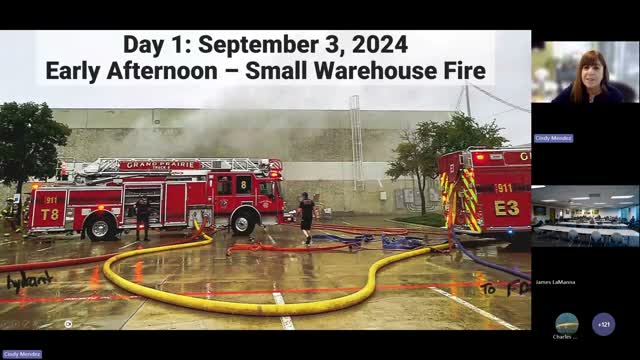
Summary
City of Grand Prairie officials outlined a Sept. 3 firefighting‑foam backflow event that entered the drinking‑water system through a fire department connection, prompted a do‑not‑use advisory for a pressure plane serving roughly 60,000 people, required millions of gallons of flushing and bottled‑water distribution, and led to pending lawsuits.
Cindy Mendez, director of public health and environmental quality for the City of Grand Prairie, described a Sept. 3, 2024 incident in which firefighting foam entered the city’s drinking‑water distribution system via a fire department connection (FDC) placed upstream of a backflow preventer.
Mendez said the event began after a small industrial warehouse fire in the Great Southwest Industrial Area. When a fire engine activated a foam pump and connected to the facility FDC, foam backflowed into the distribution system; the FDC connection point was upstream of a backflow preventer and a single check valve in the street (installed decades earlier) appears to have failed. The city received its first complaint about foamy water in the afternoon and identified foam coming from hydrants.
"We were able to restore water in about 45 hours from the time residents were notified of do not use," Mendez said, summarizing the emergency response timeline. The city activated its emergency operations center, isolated the affected pressure plane (serving about 60,000 people), flushed approximately 4.5 million gallons within about 48 hours, distributed more than 600,000 bottles of water, and conducted clearance sampling. TCEQ’s toxicology staff reviewed confirmation testing.
Mendez said the city used methyl blue activated substances (MBAS) as the clearance indicator because roughly 30% of the product (Micro Blaze) consists of MBAS; locating a laboratory with a fast turnaround time required flying samples to a lab in Corpus Christi. Some samples showed very small quantities of surfactant below secondary standards; the TCEQ approved lifting the do‑not‑use order after the agency reviewed clearance sampling.
The city closed some schools and businesses during the advisory, deployed health inspectors to affected facilities, provided bottled water and donations, and continues to deal with legal claims; Mendez said cost estimates remain preliminary but described potential liability in the millions of dollars. She urged utilities to review fdc/backflow placement and to coordinate early with emergency operations, local fire marshals and TCEQ. The TCEQ remediation division will send postcards to residents living within a mile of identified contaminated wells—a separate update noted during the meeting.
What happened next: Grand Prairie submitted a remediation and response plan to TCEQ that was approved overnight so clearance sampling could begin; the city and TCEQ coordinated sampling, modeling and communication to restore service and rescind the public notice.