Get AI Briefings, Transcripts & Alerts on Local & National Government Meetings — Forever.
Nebraska hearing considers joining respiratory care interstate compact; DHHS seeks delayed start over FBI background-check timing
Summary
Sen. Victor Rountree introduced LB735 to allow respiratory therapists licensed in other member states to obtain compact privileges in Nebraska; proponents cited workforce mobility and 1,700 licensed therapists, while DHHS asked to delay implementation until at least Jan. 1, 2027 to allow FBI approval of statutory background-check changes.
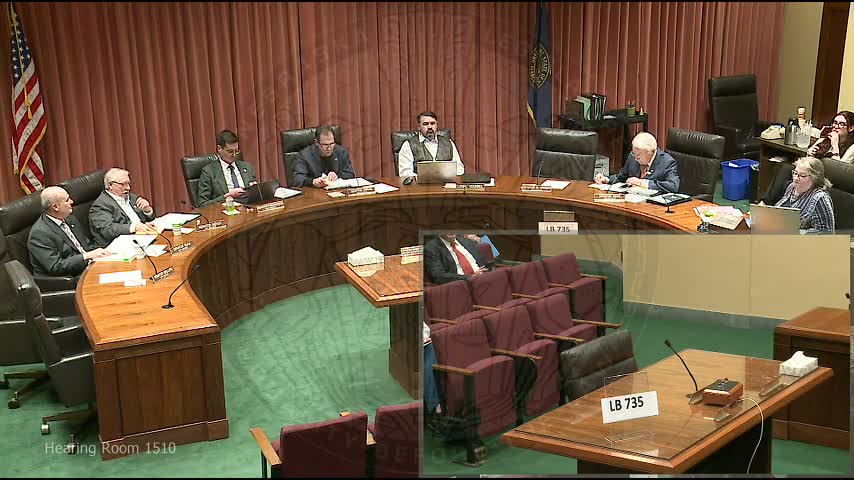
Senator Victor Rountree, District 3, told the Health and Human Services Committee that LB735 would make Nebraska a member of the Respiratory Care Interstate Compact, allowing licensed respiratory therapists from compact states to obtain a license privilege in Nebraska without a full duplicate licensure process. "This compact aims to provide greater mobility for licensed respiratory care therapists," Rountree said as he introduced the bill.
Heather Nichols, vice president and chair of the legislative committee for the Nebraska Society of Respiratory Care, testified in support and emphasized both patient access and operational efficiency. "Allowing greater mobility shows that Nebraska is a worker-friendly state ready for new providers to practice in our communities," Nichols said, noting the state has about "1,700 licensed therapists in the state currently." Marcy Wyrens, chairperson of the Board of Respiratory Care, said the compact would ease cross-border care, particularly for home-care pediatric patients and traveler clinicians covering hospitals near state lines.
Committee members asked about a $38,000 fiscal note tied to software and data-interface costs for sharing licensure information. Nichols said the state could set fees to cover the compact database costs and that fees would likely be charged to licensees seeking compact privileges. "So we could choose that to cover the cost of the software," Nichols said.
Senator Rountree also read comments submitted by the Department of Health and Human Services (DHHS), which recommended language changes and requested a delayed implementation date. DHHS said changes to a criminal-background-check statutory section cited in testimony as "section 38 1 31" would require FBI approval and thus asked the committee to amend the bill to delay the compact's effective date until at least Jan. 1, 2027 so background checks could be conducted when the law becomes effective.
The hearing record did not include a committee vote on LB735; Rountree said he would remain available to work on language and amendments. The committee then moved on to the next bill.