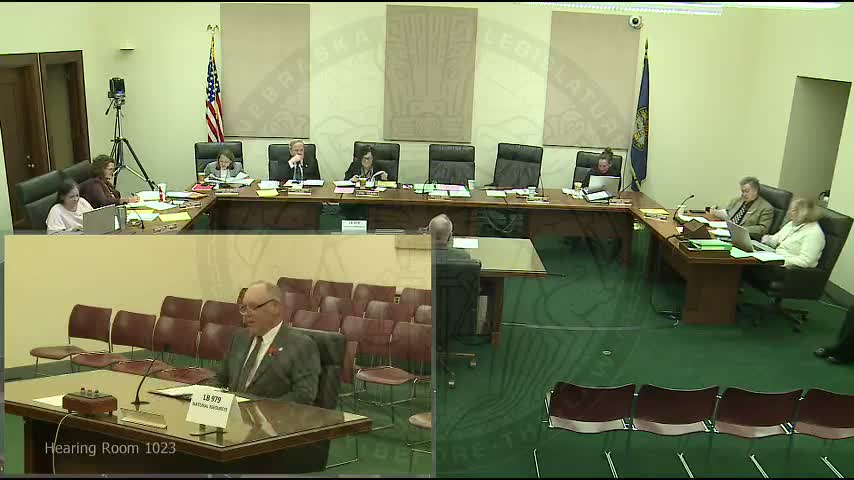
Natural Resources Committee examines Game and Parks bill expanding fees, investigative tools and penalties for wildlife trafficking
Get AI-powered insights, summaries, and transcripts
SubscribeSummary
LB979 would update Nebraska Game Law to clarify abatement work, allow modest fees for education programs, expand investigative-cash-fund uses (including technology or undercover vehicles), adjust fee caps, and create a felony for large-scale wildlife commercialization (threshold cited at $10,000 aggregate over three years). Senators sought more legal analysis on the felony provision and questioned fee impacts.
LINCOLN, Neb. — The Natural Resources Committee took testimony on LB979, a broad Game and Parks bill that would modernize several sections of Nebraska’s game law, increase certain fee caps, allow the agency to accept donations and set modest fees for requested education programs, and expand the use of the game law investigative cash fund for training, technology and potentially investigative vehicles.
Sen. Tom Brandt introduced the bill and Tim McCoy, director of Game and Parks, provided an overview of proposed changes. McCoy said the bill corrects a statutory definition of abatement to reflect work the agency already performs, allows the Game and Parks board to adjust certain programs by rule rather than statute, and seeks to update long-unchanged fee caps. He told the committee that many resident and nonresident fee caps have not been raised in more than a decade and that the commission has generally increased caps by about 30% when the subject has been revisited.
McCoy said the agency wants authority to charge moderate fees for requested wildlife-education programs to offset some costs; such fees would not apply to Title I schools or grant-funded programs. He also described using the investigative cash fund for undercover or less-identifiable vehicles and modern equipment to help pursue sophisticated illegal-harvest operations.
A new criminal provision drew the most sustained questioning: McCoy said the bill would create a felony for "wildlife commercialization and trafficking" aimed at large-scale, organized, for-profit illegal operations, with a threshold tied to an "aggregate value of $10,000 or more within 3 consecutive years." Several senators pressed for supporting legal analysis and examples; one committee member noted such cases have in some instances been prosecuted under the federal Lacey Act when interstate commerce was involved, and asked whether existing state laws or other criminal statutes could already address the conduct.
Questions also focused on how lifetime permit caps are calculated (McCoy described aligning some lifetime stamps to a 20-times-annual-fee rule), specific proposed fee examples (the director cited adjusting nonresident antelope to match existing nonresident deer fees, roughly $369), and the agency’s revenue mix (McCoy said the agency is primarily funded by cash and user fees, describing roughly '93% cash and user fees' with a small general-fund share). Senators asked for more legal detail on when a felony is necessary rather than administrative sanctions such as license revocation.
McCoy said agency staff would follow up with additional information and that the proposal for the trafficking provision was modeled on statutes in other states to address in-state, organized commercialization that may not be covered by federal law. The hearing ended with the committee requesting more information on the felony component and fiscal implications; no opponents were recorded in the transcript.