
King George schools warned of steep insurance renewal after claims spike
Get AI-powered insights, summaries, and transcripts
Subscribe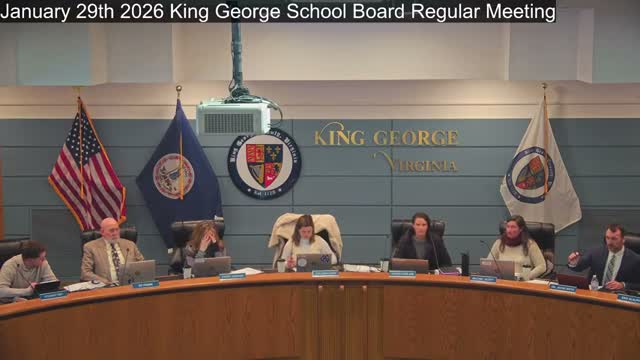
Summary
A Mark 3 broker told the King George County School Board that medical claims have risen sharply—about $5 million in medical plus nearly $3 million in estimated pharmacy spend—producing an estimated $8.6 million package and a conservative 18% projected increase for plan year 2026–27. The board pressed for detail on pharmacy reporting, high‑cost claimants and alternatives to Local Choice.
Heath Thomas, a broker with Mark 3, told the King George County School Board that the school division’s health‑insurance renewal is imminent and that recent claims activity warrants concern. "All those things combined bring us to an $8,600,000 estimation for the 2026–27 plan year. That is an 18% increase over where you currently are," Thomas said during the board’s presentation on benefits and renewal assumptions.
Thomas reviewed claims for the 10/01/2024–09/30/2025 window the board is expected to use for renewal calculations. He said the division is currently showing about $5,000,000 in medical claims on the reporting extract and—based on his firm’s analysis—he estimated an additional pharmacy spend just under $3,000,000 that is not included in the medical figure. He identified 38 "high cost claimants," several with annual claims above $200,000, and noted that a single month (October) produced roughly $1,300,000 in paid medical claims, an outlier that will affect the renewal.
Board members pressed Thomas to explain how Local Choice (the blended municipal arrangement run with Anthem) calculates credits and reserves, asking whether low‑claim months offset spikes and how pharmacy data are reported. Thomas said Local Choice provides limited pharmacy transparency and that Anthem’s blending and reserve calculations are governed by behind‑the‑scenes aggregation of participating groups. On alternatives, he warned that moving to a self‑funded model would transfer more risk locally and would require substantial stop‑loss/reinsurance decisions.
Dr. Boyd, the superintendent, and several board members asked what steps the division could take to moderate future increases, including wellness programs, deeper claims audits and shopping the plan if the renewal comes in above the board’s tolerance. Thomas said wellness initiatives can be offered, but under Local Choice they rarely translate directly into dollar‑for‑dollar rate relief; he reiterated that a firm renewal from Anthem was expected very soon.
The board did not take immediate action on benefits; members said they would review the firm renewal when provided and consider whether to absorb some or all of any increase as they finalize the FY27 budget.