
Elkhart Schools: SEA 1 will shrink taxable base, policy analysts warn of cash shortfall by 2028
Get AI-powered insights, summaries, and transcripts
Subscribe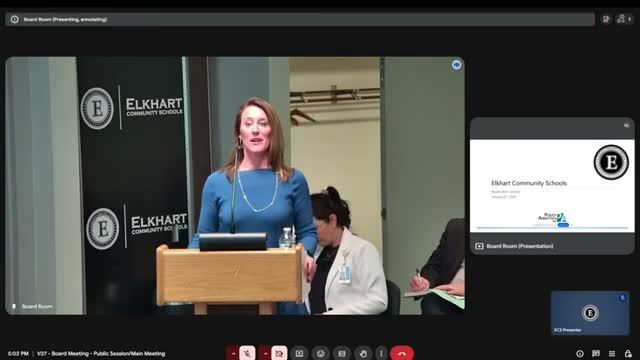
Summary
Policy Analytics told the Elkhart Community Schools board that Indiana’s Senate Enrolled Act 1 will produce large new deductions and credits that reduce the district’s net assessed value and create millions in unfunded credits; without cuts or new revenue the district’s cash balance could be exhausted around 2028.
At a public work session, Policy Analytics consultant April Fitterling told the Elkhart Community Schools board that Indiana’s Senate Enrolled Act 1 will substantially reduce the district’s taxable base and create recurring “unfunded credits” that shrink revenue available for operations.
Fitterling summarized SEA 1 as a five‑year package of changes that increases homestead deductions, creates a 10 percent or $300 maximum homestead credit, expands new deductions for the 2 percent tax class, and raises the business personal property exemption threshold. She said those elements together will lower Elkhart’s net assessed value and compress revenue in coming years.
Why it matters: net assessed value is the starting point for local levies; deductions and credits reduce the amount on which levies are calculated. Fitterling quantified the effect the board should expect: she told trustees the 2027 business personal property change alone accounts for a roughly $238,000,000 reduction in the district’s net assessed value, and that combination of deductions and exemptions drives a projected 5.1 percent drop in net assessed value in 2027.
Fitterling and her team modeled how those reductions interact with the district’s certified levies and circuit‑breaker mechanics. She said traditional circuit‑breaker losses and the new homestead credit together push unfunded credits into the operations fund and, depending on whether the debt‑service fund is statutorily protected, could shift hundreds of thousands of dollars between funds. In one modeled scenario she described operations‑fund impacts reaching roughly $5.5 million in 2027.
On cash flows, Fitterling warned that, absent additional measures, the district’s revenue shortfalls would outpace planned expenditures and begin depleting reserves: “If nothing is done…we will see that negative cash balance going forward,” she told the board. She showed baseline projections in which ongoing structural deficits would consume rainy‑day funds by about 2028 and described how modeled cost reductions — the presentation used a $3 million starting reduction in 2026 and additional reductions in 2027 — delay but do not eliminate the shortfall unless sustained and expanded.
Board members asked for comparative historical figures and clarification about what propped up earlier cash balances; Fitterling said one‑time COVID (ESSER) dollars between 2020 and 2023 had boosted balances and many recurring expenditures persisted after that funding ended. She emphasized that once those one‑time revenues disappeared, repeated staffing and service costs continued to exert pressure on the education and operations funds.
Options and next steps: Fitterling framed the district’s choices as twofold — run an operating referendum to raise revenue or institute cost reductions — and said Elkhart’s leadership is modeling cost reductions because an operating referendum was not judged a viable near‑term option. The presenter and trustees agreed earlier and sooner cuts yield larger compound benefits in later years; the administration said it will return with more detailed proposals and updated cash‑flow visuals.
The board received the presentation and asked staff to continue modeling scenarios and to present proposed cost‑reduction options at upcoming meetings.