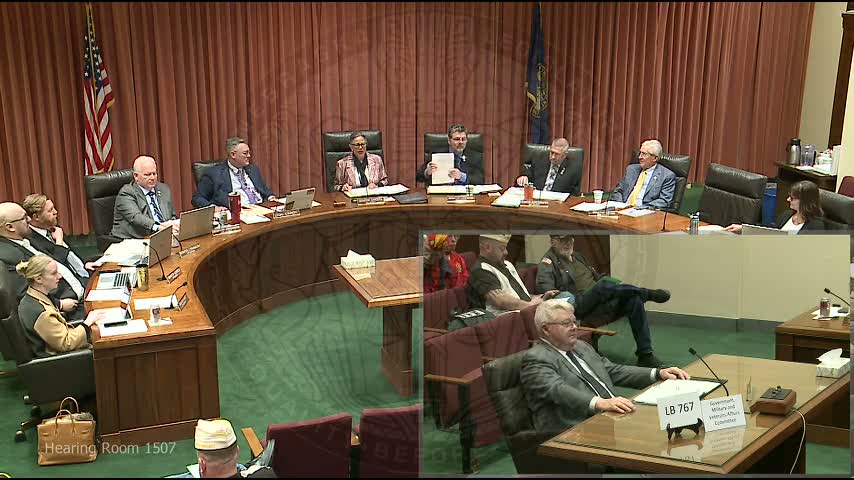
Nebraska hearing pits county VSOs and veterans groups against bill to regulate paid claims consultants
Loading...
Summary
Senators heard hours of testimony on LB 767, which would set state rules and fee limits for third‑party veterans claims consultants. Supporters said it adds guardrails and consumer protections; a broad coalition of county VSOs and veterans organizations urged defeat, saying it would legitimize predatory, non‑accredited actors and may conflict with federal law.
Lincoln — The Government, Military and Veterans Affairs Committee heard competing views on LB 7 67 on the bill’s intent and likely effect. Sponsor Senator Rick Holdcroft said the measure creates a regulatory framework for people who offer and charge fees to assist veterans with VA disability claims, requiring written agreements, disclosures that free options exist and limiting contingency compensation to five times the monthly benefit increase.
Proponents argued the bill would protect veterans from misleading actors while preserving choice. Peter O'Rourke, president of the National Association for Veterans Rights, said the bill "strengthens consumer protections for veterans while creating clear, enforceable standards" and helps veterans differentiate between "good and bad actors." John Blomstrom, a Marine Corps veteran who owns a ranch, told the committee, "This is not anti veteran. That's pro consumer and pro choice."
Opponents, led by accredited county veteran service officers and major veterans organizations, urged rejection. Mark Lakam, Lancaster County veteran service officer, told senators he believed portions of LB 7 67 conflict with federal law and cited 38 U.S.C. and related VA regulations restricting who may prepare certain claims; he also estimated that allowable rates could prospectively send "about $2,780,000" out of Lancaster County. Ken Yount, speaking for multiple veteran service organizations, said LB 7 67 would "legitimize the work of non‑accredited claim consultants" and remove critical federal oversight and accountability.
Several accredited county VSOs described how their offices provide claims assistance at no charge and have direct access to VA systems and appeals processes. Eric Mulally of Platte and Colfax counties described a case in which a veteran paid roughly $6,000 to a private firm and later lost a rating on VA review but remained liable for the fee. Philip Hune, a county VSO, ran hypothetical math showing that a 100% rating (monthly $3,938) multiplied by five could total $19,692 in fees under the bill’s cap, a figure he said was "too much."
Veterans groups including the VFW, American Legion and the Nebraska Veterans Council voiced united opposition, saying the state should instead strengthen accreditation (LB 693 was referenced repeatedly) and enforcement of existing protections. Jeffrey Baker of the VFW said LB 7 67 "protects greed, and it shields the bad actors" and accused paid consultants of funneling veterans' benefits into organized lobbying.
Senator Holdcroft closed by reaffirming the bill is intended to preserve choice while adding safeguards and said he would work with colleagues to reconcile LB 7 67 with proposals that increase accreditation. The committee did not take a vote in the transcript and moved on to other bills.
The hearing record includes written attachments and referenced federal materials (38 U.S.C., 38 CFR) submitted by opponents; committee members signaled interest in further committee work to try to harmonize competing proposals.