
Nebraska committee hears sharp split over updating electrical code to 2026 NFPA
Get AI-powered insights, summaries, and transcripts
Subscribe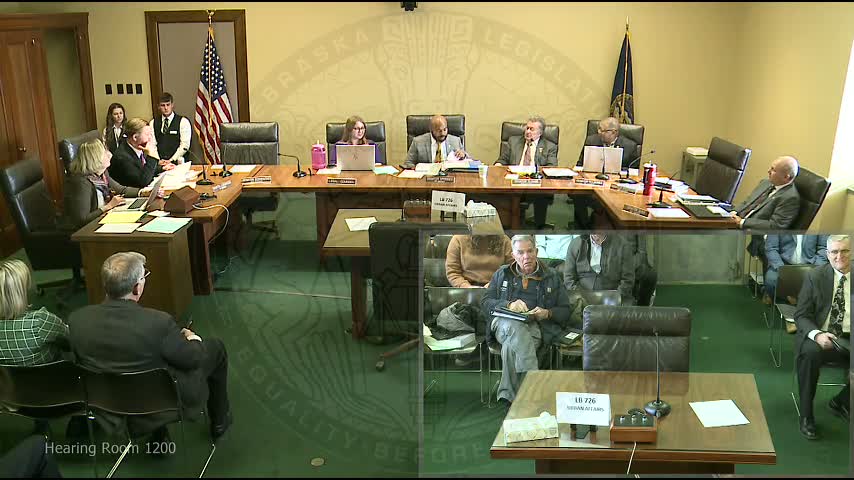
Summary
The Urban Affairs Committee heard hours of testimony for and against LB726, which would adopt the 2026 NFPA electrical code with several amendments. Proponents cited firefighter safety and nuisance‑trip reductions; builders and realtors warned added requirements (basement GFCIs, whole‑house surge protectors) raise costs and could squeeze affordable housing.
Lincoln — The Nebraska Urban Affairs Committee on Thursday heard extended testimony on LB726, a bill from Sen. Dan Quick to update the state electrical code to the 2026 edition of NFPA 70.
Quick, the bill’s introducer, said the update is primarily about safety and clarity and that LB726 is drafted to restore selected safety items while excluding others judged to be costly for new homes. “The overarching goal of electrical code is safety,” Quick said, adding that the State Electrical Division and stakeholders worked through the changes.
Craig Thielen of the State Electrical Board told the committee the 2026 edition mainly clarifies and reorganizes prior material and that the board supports reinstating 120‑volt GFCIs in unfinished basements and surge protection while leaving more expensive items — such as certain 240‑volt GFCIs and external emergency disconnects for single‑family dwellings — out of the state minimum. Thielen said the board provided handouts to show material price differences and estimated the items being reinserted would add roughly $50 in parts, while the previously amended‑out items totaled about $500.
Builders and housing groups pushed back. Nick Dolphens of the Metro Omaha Builders Association and witnesses from the Nebraska State Home Builders Association and local home builders said the parts estimates omit labor and that installed costs are considerably higher; several witnesses estimated an installed cost closer to $1,000–$1,500 per house depending on whether the work is new construction or retrofit. “Every $1,000 increase in the cost of a home prices out hundreds of Nebraska households,” Lynn Fisher of the Nebraska Realtors Association told senators.
Opponents argued some measures on the table — particularly whole‑house surge protectors and additional appliance receptacle GFCIs — are not demonstrably life‑safety improvements and impose a retrofit burden on existing housing stock. Builders said GFCIs can cause nuisance tripping that leads to complaints and that forcing whole‑house surge protection risks outages in rural areas where line quality is inconsistent.
Proponents emphasized firefighter safety and nuisance‑trip mitigation. Thielen described the emergency disconnect as a way for firefighters to cut power without creating arc‑flash risk when removing a meter, and he said surge protection can reduce false trips of AFCI devices that have created problems in new homes.
Several senators probed what the state’s adoption would mean for municipal codes. Thielen said municipalities must meet the state minimum but are free to adopt more stringent local standards. Senators asked whether adopting LB726 would force cities such as Omaha to change local ordinances; witnesses said cities could keep stronger local requirements but that adoption of the 2026 state baseline would be the minimum.
No formal committee action or vote occurred at the hearing. Chair Sen. Terrell McKinney said he will consider amendments and is open to proposals that balance safety with housing affordability. The hearing record showed in‑person testimony from multiple proponents and opponents and one opponent comment submitted online.