Get Full Government Meeting Transcripts, Videos, & Alerts Forever!
Get email alerts on the State Of The State topic
No spam. Unsubscribe anytime.
Governor Jim Pillion outlines deep spending cuts, business tax credits and public‑safety priorities in State of the State
Summary
In his State of the State address, Governor Jim Pillion pushed a budget he said would cut spending and produce a $500 million biennial improvement, proposed a decade‑long 10% business tax credit to spur job growth, highlighted $218 million in rural health funding, and urged changes to public power law to support energy‑intensive AI facilities.
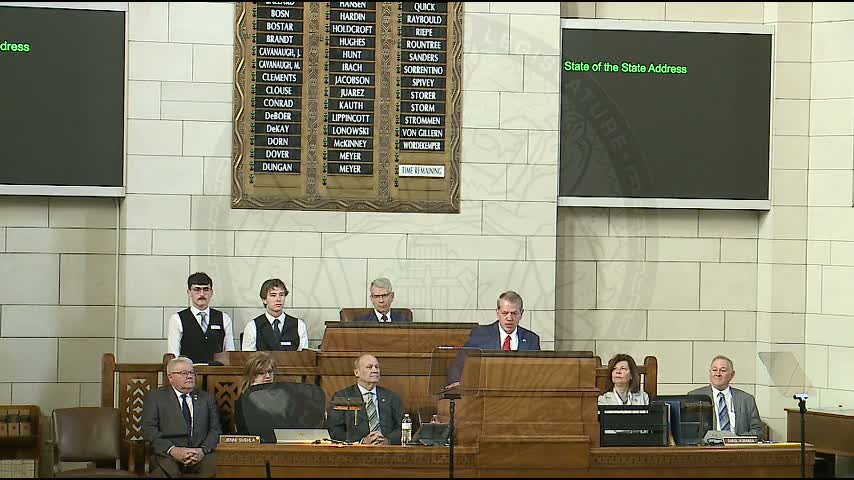
Governor Jim Pillion delivered the State of the State to the 109th Nebraska Legislature, framing the address around fiscal restraint, economic growth incentives and public safety.
"The result of this budget will mean a $500,000,000 improvement to the state's bottom line in this biennium," Pillion said, outlining a proposal he said pares state spending while preserving targeted investments. He said the state also holds "a nearly $2,000,000,000" general fund reserve and more than $1.3 billion in unobligated reserves after planned transfers.
Pillion highlighted health and public‑safety developments. He said Nebraska secured "over $218,000,000 for 2026 alone" from a federal rural health transformation program and praised six Omaha Police Department officers who confronted a December 3 shooting in which three officers were wounded. He listed the officers by name and asked the chamber to recognize them for their actions.
On economic development, Pillion proposed the "Grow the Good Life Incentive," a business tax credit that he described as a 10% credit for a full decade for companies that expand in Nebraska and add high‑paying jobs. "This is groundbreaking," he said, and named Senator Von Gillen as the bill carrier.
Noting growth in population and the economy, Pillion stressed energy and electric generation as keys to future competitiveness. He argued that Nebraska must remove barriers for large power users and allow "behind‑the‑meter" generation that lets companies build on‑site power and sell excess electricity to the grid, saying modest public‑power law changes (carried by Senator DeQue) are needed to attract data centers and other energy‑intensive industries.
Pillion also touted agency savings and fraud reductions. He said Department of Health and Human Services achieved "unprecedented net savings of a $141,000,000 this biennium," and that $30,000,000 was returned to taxpayers by cutting off ineligible out‑of‑state Medicaid claims.
On education, Pillion said he secured a commitment from University of Nebraska leaders that any Nebraska student who scores a 33 or better on the ACT will be offered a full scholarship with housing. He introduced Michelle Thorn, an academic support coach from Grand Island, and said a 2023 law preventing suspensions for disruptive kindergarten through second‑grade students had "unintentionally" damaged classroom experience and that legislation carried by Senator Murman will seek to correct that.
He raised agriculture and civil‑rights items: defending farmer control of production data and urging passage of Senator Jacobson's ag data privacy proposal; and asking the chamber to send Senator Hardin's LB 538 (an antisemitism definition measure) to his desk with bipartisan support.
On a high‑profile election issue, Pillion urged passage of LR24CA, carried by Senator Doran, to put a question on the November ballot about changing how Nebraska awards electoral college votes.
Pillion closed by recognizing veterans and calling for unity during the legislative session.
The speech was preceded by a committee appointment motion to escort the governor into the chamber (motion moved by Senator Clemens and adopted). The clerk subsequently read a large slate of new bills and statute reissues. The session later took procedural actions including notices of committee hearings and a motion to adjourn.