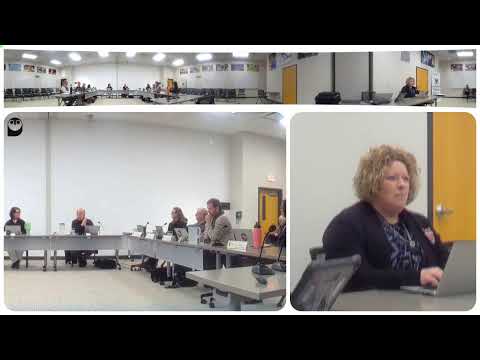
District presenters cite distributed leadership and big attendance gains at alternative high schools
Loading...
Summary
Administrators described distributed leadership, use of Wayfinder and PLCs, and reported sharp attendance gains at the district's alternative model schools; board members pressed for data on benchmarks, ACT writing and how scheduling supports belonging.
Speaker 1, the presentation lead for the high‑school report, said the district’s high‑school work is “grounded in our…district mission” to “know our students' stories and put upon their strengths.” The presentation outlined two distinct high‑school designs in the Middleton‑Cross Plains Area School District and emphasized distributing leadership to teachers to improve outcomes.
The presenters described Clark Street as a personalized, multi‑subject, multi‑grade, seminar‑based model that “emphasize[s] relationships, agency, belonging, and community,” and Hudson High School as centered on the premise that “belonging relationships are the foundation for learning.” Speaker 4 said, “Simply put, students can't perform at their best if they don't feel like they matter and they're supported,” and described developmental designs and an online tool, Wayfinder, that staff use for identity and purpose lessons.
Presenters gave concrete benchmarks the district is using to measure instructional change. Speaker 5 said staff set a 25% target for seminars to include mathematical elements; reporting later in the presentation showed the district exceeded that target in term 1, with 54.5% of seminars containing math elements and 45.5% in term 2. For literacy, presenters described a district goal of 70% of students producing 20 literacy‑based artifacts or demonstrating a 150% growth over prior performance for struggling learners.
Attendance and engagement were central examples used to show the models’ effects. Speaker 5 reported that freshman attendance at Park Street rose from “50% last year to 92.45% in term 1” and said overall school attendance for term 1 rose from “25.2%” to “88.6%” (figures presented by the presenter during the meeting). Board members asked follow‑up questions about how engagement survey data (the LEAP survey administered through Transcend/Mastery Transcript Consortium) links to rigorous classroom standards and whether higher engagement equates to greater learning. Speaker 1 noted the district opts into the ACT writing component to add a separate data point on growth.
Board members pressed for additional details about students who remain unconnected to activities and about schedule complexities for a 2,400‑student high‑school population. Speakers acknowledged scheduling limits while emphasizing that developmental designs aim to build strategic classroom interactions so students develop connections even when schedules rotate.
The presentation concluded with an offer to provide the board and community a written product with more detailed numeric breakdowns.
Ending: The board thanked presenters and moved on to the capital maintenance plan section of the agenda.