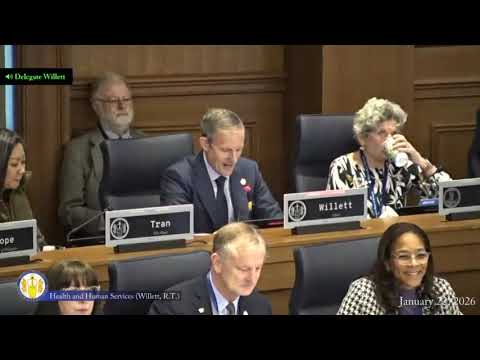
Health committee reports package of bills on contraceptives, pools, pharmacy access, food-allergy notices and more
Loading...
Summary
The House Health, Human Services Committee reported a package of subcommittee-referred bills, including a pharmacy access pilot (HB335), adoptee birth-certificate access (HB301 substitute), and multiple public-health measures; most measures passed committee votes and some were referred to appropriations.
The House Health, Human Services Committee considered a series of bills presented by health subcommittee Chair Delegate Hope and other delegates, and recorded roll-call outcomes for each item.
HB 817 (Delegate Downey) — Department of Medical Assistance Services reporting: Downey said HB 817 would exempt the Department of Medical Assistance Services (DMAS) from the annual reporting requirement for the state-local hospitalization program if the program receives no state or federal funding; he explained the program has not received General Assembly funding for many years and the annual report only documents lack of activity. The committee reported the bill 19–1.
HB 6 (Delegate Price) — contraceptive access: The subcommittee recommended reporting and the full committee reported HB 6; the transcript indicates a committee vote of approximately 13–7. The bill establishes a right to obtain contraceptives and clarifies it does not permit involuntary sterilization; it also creates a private cause of action for rights infringements as defined in the bill.
HB 222 (Delegate Hope) — Board of Health pool regulations: The committee adopted a subcommittee amendment and the bill was reported as amended; the final roll-call result was 19–2.
HB 301 (substitute) — adoptee access to birth certificates: The committee approved a substitute requiring the state registrar to provide adult adoptees access to their birth certificate and to make a contact-preference form available for birth parents; the substitute passed the committee by a roll-call result reported in the transcript as 15–6. (Transcript lists the patron as 'delegate call center' in the presentation.)
HB 335 (Delegate Anthony) — independent pharmacy access and resilience pilot: The bill would create a pilot at the Department of Health limited to 12 independent pharmacies, expiring on 07/01/2030, with a required report to the governor and General Assembly. The subcommittee recommended reporting and referral to appropriations; the full committee voted 19–1 to report and refer HB 335 to appropriations.
HB 373 (Delegate Martinez) — restaurant food allergy notice: The bill directs the state health commissioner to publish multilingual procedures for restaurant staff and requires restaurants to post a conspicuous notice (including the phrase "If you have a food allergy, please notify us"). The committee reported the bill 18–3.
HB 376 (Delegate Seibold) — SUDEP resources and investigation: The bill directs the Office of the Chief Medical Examiner to publish SUDEP information and a SUDEP death-investigation form on its website; the committee recommended reporting and referring to appropriations, and the committee voted to report and refer 20–1.
HB 380 (Delegate Bennett Parker) — celiac disease training materials: The bill would add celiac disease awareness and safety to materials used for restaurant personnel training; the committee reported HB 380 by a vote of 19–2.
HB 381 (substitute) — medical examiner notifications for organ retention: The substitute would require the Office of the Chief Medical Examiner to provide written notice to funeral service establishments if an investigation or autopsy requires retention of a whole organ and require those establishments to notify next of kin; the committee reported the substitute 20–1.
Other: The committee also referred HB 556 to the Courts of Justice committee earlier in the session.
Next steps: Most bills were either reported to the full House or referred to appropriations; several will proceed through the House calendar and hearings as scheduled.