
Subcommittee advances 15‑day limit on solitary for adults and a study to curb juvenile room confinement
Get AI-powered insights, summaries, and transcripts
Subscribe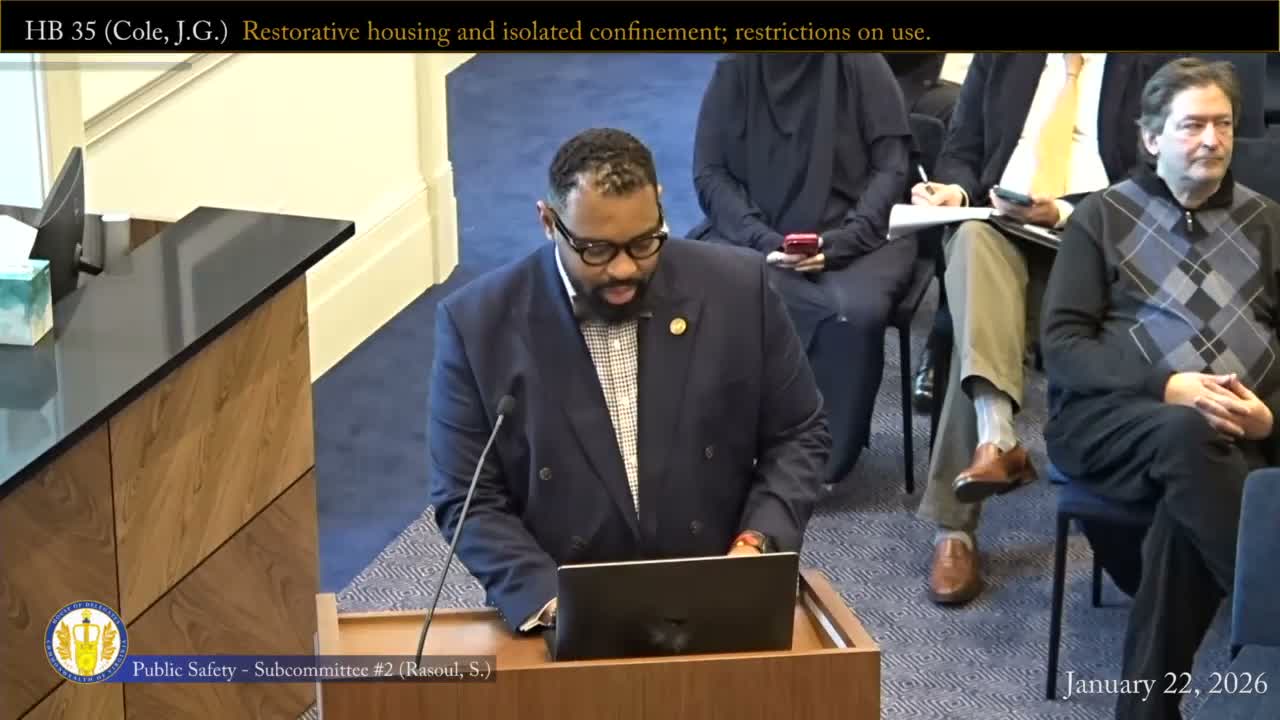
Summary
The House Public Safety Subcommittee advanced HB 35, which would cap isolated confinement for adults at 15 days (unless requested by the person), and HB 91, directing a study and standards to limit extended room confinement for youth after reports of problems at Bon Air Juvenile Correctional Center.
The House Public Safety Subcommittee moved forward two measures targeting extended isolation in Virginia custody: HB 35, which would limit solitary confinement for adults to a 15‑day maximum unless an individual requests placement, and HB 91, which directs the Department of Juvenile Justice to study room confinement for youth and recommend standards and programming.
Delegate Cole, the patron of HB 35, told the panel the change is overdue and urged final passage after previous votes in 2024 and 2025. He described the bill as “simply restricts solitary confinement to a maximum of 15 days, unless an individual themselves asks to be placed into solitary confinement,” and said survivors and experts would testify about harms of prolonged isolation.
Survivors and advocates made the case during public comment. David Smith, director of Social Action Linking Together and a self‑described solitary survivor, said Virginia’s most extreme facilities have a national reputation: “Red Onion is today’s Angola,” he said, urging the committee to change the practice. Licensed clinician Justina Rasinski, who worked at Rikers, told lawmakers, “People do not heal in cages,” and cited international findings that prolonged isolation can amount to torture.
Advocates asked for oversight and mental‑health reviews; the Stafford NAACP’s Yolanda Roussel urged limits, independent oversight and transparency, saying prolonged isolation “disproportionately impacts Black and mentally ill individuals and undermines rehabilitation.” Several survivors described long periods in isolation and ongoing harms to family life and mental health.
A correctional staff representative urged caution. Don Baylor of the National Coalition of Public Safety Officers, a former corrections employee, said the bill’s review language is largely positive but warned that some individuals may require continued separation for safety and that lives — both of incarcerated people and staff — can depend on careful review.
Committee members asked technical questions about documentation, oversight and costs. A legislator noted the bill includes programming expectations — proponents referenced “four hours” of daily programming and “one hour” of recreation as part of standards discussed in testimony — and asked how the Department of Corrections would implement those requirements and absorb any fiscal impacts. Delegate Cole said policies and procedures would be developed by the department.
HB 91, introduced by Delegate Seebold and shepherded through a Commission on Youth work group after media and inspector general reports about fires and disturbances at Bon Air Juvenile Correctional Center, focuses on youth. The measure directs DJJ to study room confinement, develop trauma‑informed programming and staff training, collect program participation data, and issue recommendations to the Commission on Youth and relevant committees by Nov. 1. Commission members and juvenile justice advocates testified that excessive in‑cell confinement at Bon Air was linked to understaffing and contributed to escalating incidents.
After debate and testimony, the subcommittee voted to report HB 35 and refer it to Appropriations (the motion passed 5–2) and reported HB 91 unanimously. The committee’s action sends the bills to the next stages of consideration.