
DCF asks committee to retain $7.7M reappropriation for CCWIS, fund regional foster‑care stabilization and IT upgrades
Get AI-powered insights, summaries, and transcripts
Subscribe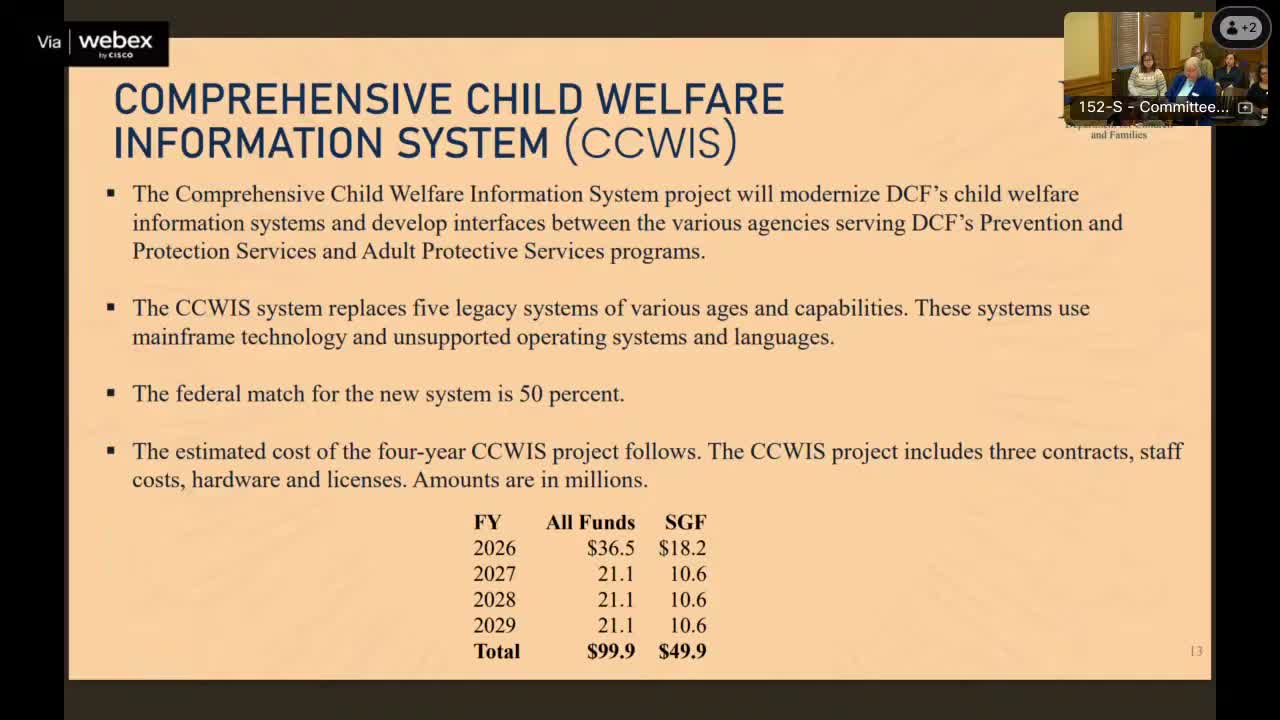
Summary
Department for Children and Families asked the Committee on Social Services Budget to allow retention of a $7.7 million CCWIS reappropriation, to support targeted foster‑care stabilization in Sedgwick County, and to fund several IT upgrades and contract adjustments that the agency says are necessary to operate and to lower SNAP error rates.
The Department for Children and Families requested the committee restore several supplemental items and allow the agency to retain a $7.7 million reappropriation for the Comprehensive Child Welfare Information System (CCWIS). Legislative Research’s Amanda Prosser told members the CCWIS contracts were awarded but timing left about $7.7 million of state general fund unobligated and subject to sweep; DCF asked to retain those funds to pay first‑year system costs.
Secretary Laura Howard described CCWIS as a modernization that will replace five legacy systems, provide interfaces between DCF programs and providers, and permit a single case management environment for foster care contractors. Howard told the committee DCF awarded three major contracts (largest named with Red Main for design, development and implementation) and framed the reappropriation request as a timing and obligation issue rather than a new program ask.
Howard also called out several programmatic items the governor supported: targeted stabilization resources for Sedgwick County foster care (DCF reports roughly 5,300 children in care statewide and about 1,800 in Sedgwick County), funding for four additional therapists through Amber Hope, and small investments in family‑preservation services to prioritize reunification.
On contracts and procurement, the agency described options around the Equifax employment verification contract shared with KDHE: remaining in the contract could cost approximately $8 million; DCF proposed a smaller one‑time ask (~$400,000) to terminate and seek an alternative vendor. The committee asked for additional detail about whether vendor solutions (for KEYS upgrades and Accenture work) are turnkey or require development.
Other technical and administrative items include a modest Amazon Connect contract increase (~$195,000 all funds) to maintain virtual call center services; funding to issue an RFP for 12 public‑health nurse responders (just under $1,000,000) to assist assessments of infants under age 1; regional lease increases; and index/office‑technology cost adjustments driven by OITS charges.
Committee members pressed for more data: Representative King asked whether the office of early childhood transition is a dollar‑for‑dollar transfer (the agency said yes, with one FTE change to be detailed in February); Representative Carpenter and others requested the agency provide an IT budget and FTE counts to show how much is already spent on IT and whether modernization will net savings. Tammy Tompkins, the agency budget director, told the committee the agency draws down federal funds as needed and can hold federal funds only for three days before spending, sometimes letting federal balances go negative briefly and then drawing down reimbursements.
Next steps: the committee requested follow‑up documentation on CCWIS contracting, vendor scope for KEYS/Accenture work, the Equifax contract options, IT budget totals and the precise staff counts tied to the SNAP staffing request before acting on supplemental restorations.