
DCF warns HR 1 will shift SNAP costs to Kansas; seeks tech, staffing and $12.1M in FY27
Get AI-powered insights, summaries, and transcripts
Subscribe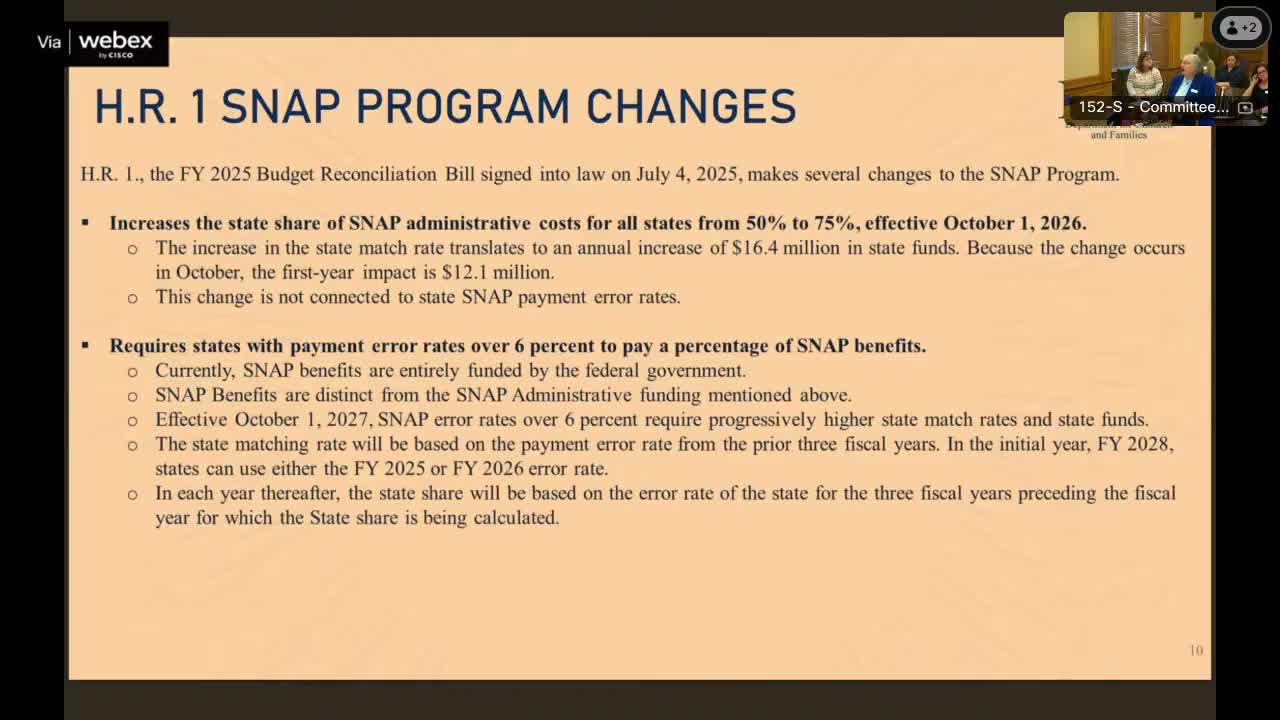
Summary
Department for Children and Families told the Committee on Social Services Budget that HR 1’s changes to SNAP would shift administrative costs to the state and could expose Kansas to benefit liabilities tied to a payment‑error‑rate metric; DCF requested technology investments and staffing to reduce error rates and $12.1 million SGF in FY27.
Amanda Prosser, a Legislative Research analyst, opened the Committee on Social Services Budget hearing by walking members through the Department for Children and Families’ budget and supplemental requests. She told the committee the agency’s approved current‑year appropriation is just over $1 billion in all funds, including about $465 million in state general fund. The presentation moved quickly to the items tied to SNAP and HR 1, which the agency says are the most consequential budget drivers.
The agency and its secretary framed HR 1 as a federal cost shift rather than a performance finding. Secretary Laura Howard described the changes as a federal law (HR 1, the federal 2025 budget reconciliation bill) that will increase the state’s share of SNAP administrative costs from a 50% match to a 75% match effective Oct. 1, 2026. “This has nothing to do with state performance…this is literally just a cost shift that the federal government is placing on the states,” Howard said. DCF estimates that shift will cost about $12,100,000 SGF for the last three quarters of fiscal year 2027 and roughly $16,400,000 SGF annually thereafter.
Howard also explained the bill creates a payment‑error‑rate liability beginning in federal fiscal year 2028: if a state’s SNAP payment‑error rate is under 6%, the benefit side remains fully federally funded; higher error rates trigger a sliding state match (5% at 6–7.9%, 10% at 8–9.9%, and 15% at 10% or higher). Howard provided the agency’s recent measures: Kansas had error rates as high as about 12% after the pandemic, federal FY24 fell to about 9.98%, and DCF’s most recent four‑month average was about 7% with the latest month at 5.5%.
To avoid future liabilities under those rules, DCF asked the committee to fund a package of technology and program changes aimed at sustaining lower error rates. The request includes automation and quality‑assurance tools (a described “quality assurance application” or chatbot to assist staff with complex SNAP rules), targeted data‑driven case‑identification tools, and communications improvements to reduce client errors. Amanda Prosser and Secretary Howard both said some items would require vendor work (Amanda referenced Accenture for certain KEY system changes tied to payment‑error mitigation).
Staffing and program changes tied to SNAP work requirements also drew questions. Prosser told the committee DCF currently has 19 non‑supervisory case managers supporting roughly 1,100 SNAP participants monthly in the work‑services program; the agency estimates HR 1 will add perhaps 800–1,900 additional adults into work‑service requirements depending on categories counted. The department asked for funding to support about 32 staff (phased three months in the current year and full‑year in FY27) to serve the expanded population while relying largely on existing vacant FTE rather than creating new permanent positions.
Committee members probed the math and whether technology alone could produce the necessary reduction in human error; Representative Carpenter said the requested technology amounts appeared large relative to recent performance improvements, and other legislators asked for more detailed IT budgets and FTE lists before voting on restorations. Secretary Howard urged the investments as protection against potential multi‑million‑dollar liabilities if error rates rise, saying the technology buys “cushion” and makes reductions more sustainable amid staff turnover and caseload changes.
Next steps: DCF will face public testimony on the budget the following day, and committee members asked agency staff to supply more detailed breakdowns — including the IT budget, FTE detail, and whether particular vendor solutions are turnkey or developmental — before the committee acts.