
Judicial Committee hears bill to criminalize AI deepfake identity fraud
Get AI-powered insights, summaries, and transcripts
Subscribe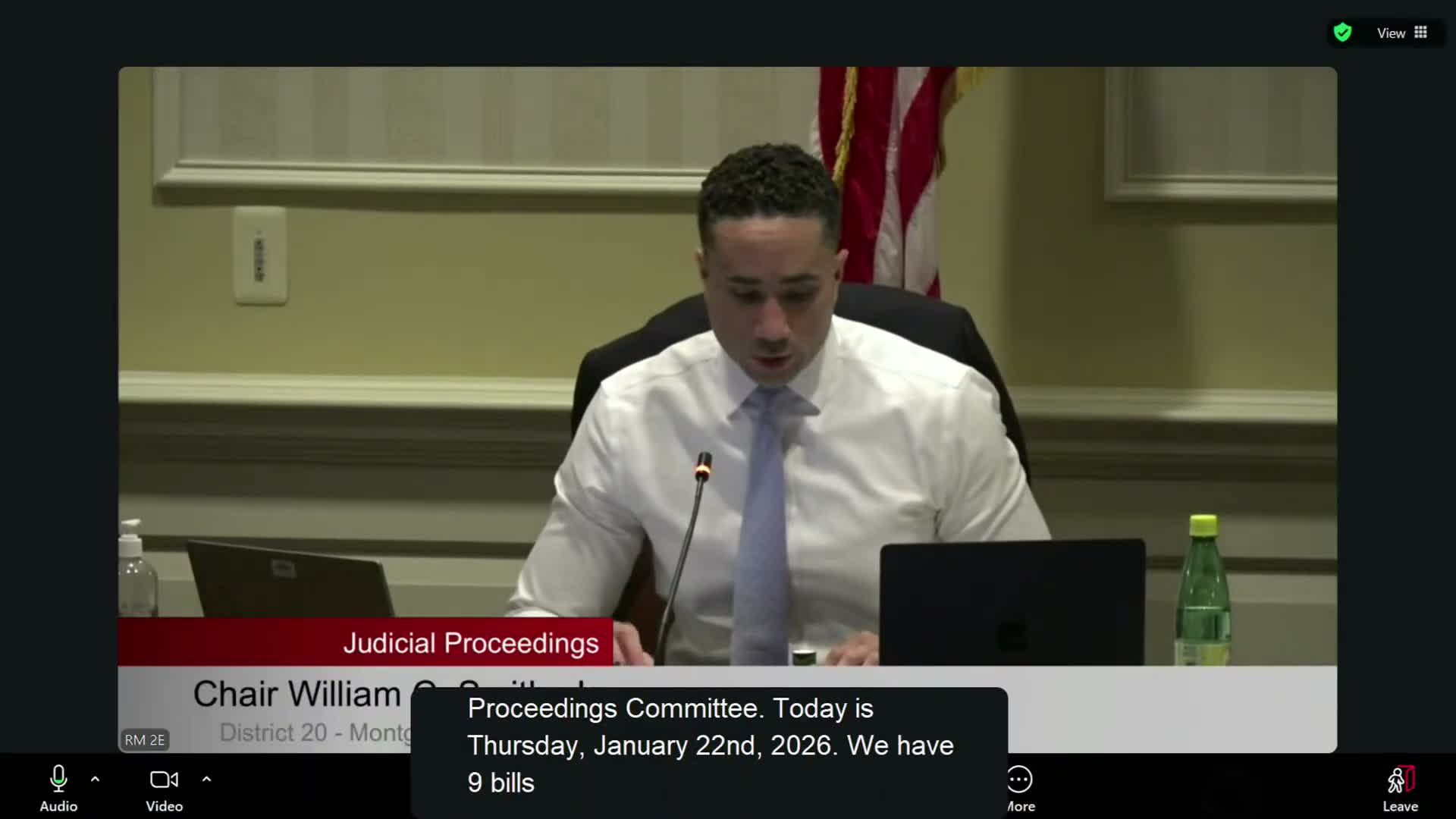
Summary
Senate Bill 8 would expand Maryland's identity-fraud law to cover AI-generated impersonations and biometric misuse, creating civil remedies and tying penalties to harm; prosecutors and advocates said current statutes leave gaps exposed by recent local incidents.
Senator Susan Hester urged the Judicial Proceedings Committee to approve Senate Bill 8 on Thursday, saying Maryland needs new tools to prosecute identity fraud powered by artificial intelligence.
"We are not criminalizing AI," Hester said, arguing the measure targets "the attempt to defraud" using synthetic media. The bill would add AI-enabled impersonation to Maryland's identity-fraud statute, expand personally identifiable information to include biometric data such as voiceprints and iris images, and authorize victim civil actions and restitution.
Prosecutors told the committee the proposal addresses a practical gap. "I was one of the assigned prosecutors in the case involving the Pikesville principal," John Cox, deputy state's attorney for Baltimore County, said, describing how investigators struggled to fit the conduct into existing criminal statutes. Miss David, who led many of the bill's prosecutorial examples, warned that current law forces prosecutors to "go through the law book to try to fit the square peg in the round hole."
Supporters cited the 2024 Pikesville High School incident in which an athletic director used inexpensive synthetic-audio services to create a false recording attributed to the principal, sparking community outrage. Hester said those events show how easily low-cost tools can cause financial, reputational, and emotional harm: the bill targets use of synthetic media "with the intent to defraud, mislead, or cause harm, including physical injury, serious emotional distress, or economic damages."
Committee members pressed sponsors on intent and free-speech limits. Proponents said the bill preserves First Amendment protections for satire and art by keeping the criminal offense tied to knowledge, willfulness and fraudulent intent and by borrowing a harms definition used elsewhere in Maryland law: physical injury, serious emotional distress, or economic damages.
Miss David and Cox said investigators rely on contextual evidence ' communications, witnesses, and surrounding facts ' to prove intent. "We have to make an investigation to prove the intent," Miss David said, describing lines investigators use to differentiate pranks from harmful fraud.
The hearing closed after questions from committee members. The bill won supportive testimony from prosecutors and advocates, who framed SB 8 as an update to existing identity-theft law rather than a novel speech restriction. Committee action and any amendments were not taken during the hearing; the bill moves next through internal committee process.
The committee is expected to deliberate on specific drafting and carve-outs that clarify investigatory standards and preserve established defenses while giving prosecutors clearer authority to pursue harms caused by synthetic media.