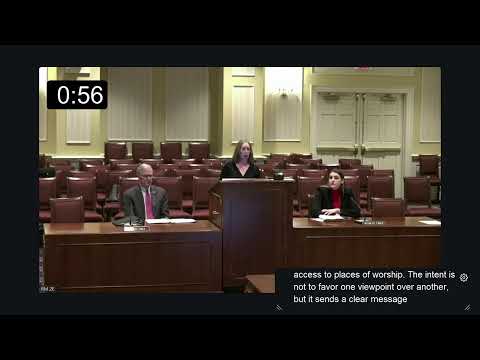
Senate committee debates recategorizing minor vehicle offenses amid data on racial disparities
Loading...
Summary
A Maryland Senate committee on Jan. 20 heard hours of testimony on SB55, which would make several non‑safety vehicle violations secondary offenses. Supporters say the change would curb pretextual stops that disproportionately affect Black drivers; law‑enforcement witnesses warned of public‑safety risks and practical hurdles.
Senator Charles Sidnor reintroduced Senate Bill 55 on Jan. 20 before the Judicial Proceedings Committee, seeking to reclassify several non‑safety vehicle violations — including short‑expired registration, certain window‑tint rules and equipment defects — from primary to secondary offenses so they cannot justify a traffic stop on their own. Sidnor framed his sponsorship in personal and local data: he told the committee about a 2019 traffic stop that made his family feel unsafe and cited Baltimore County findings that Black drivers were stopped at disproportionate rates.
"When I looked at the data," Sidnor told the committee, "black drivers were 73% more likely to be stopped by Baltimore County police than white drivers in some years, and these disparities prompted our equitable policing work group." He urged the change as a tool to reduce unnecessary stops and to refocus police on dangerous driving.
Natasha D'Artig, Chief of the Maryland Office of the Public Defender, testified in support, saying the bill would narrow pretextual stops and help rebuild trust in communities. "This bill sharpens police control," she said, adding that officers would retain authority to cite violations but would need a legitimate safety reason to stop a vehicle.
Attorney General Anthony G. Brown offered conditional support with amendments, proposing: (1) an alternative enforcement path through the Motor Vehicle Administration (MVA) for non‑safety defects (mailing repair orders), (2) authority for officers to stop drivers who present multiple secondary violations and (3) a narrower approach to any evidence‑suppression remedy that might exclude guns or other serious evidence.
Law‑enforcement witnesses urged caution. Sergeant Gerald Eaton of Harford County said reclassifying these offenses would "remove the tools our law enforcement officers use to keep our community safe" and warned that minor visible defects often lead officers to more serious discoveries, including impaired drivers. Wicomico County State's Attorney Jamie Dykes said the cumulative effect would be to make Maryland roads less safe and could increase costs for law‑abiding citizens.
Committee members pressed proponents and opponents on the scale and specifics of the problem. Sidnor supplied statewide traffic‑stop counts from the governor's office of crime prevention (GOCAP) showing that some categories, such as expired‑registration stops, numbered in the tens of thousands over an eight‑year window while other cited offenses were rare. Opponents pointed to the officer‑safety risk of pulling drivers on busy roadways and questioned how multiple secondary violations would be reliably documented in the field.
The sponsor proposed and acknowledged several amendments to narrow the bill (removing littering language and sharpening mirror/obstruction language, among others) and offered to continue behind‑the‑scenes discussions with the Attorney General's and law‑enforcement offices. The committee took testimony from a mix of municipal and statewide law‑enforcement leaders, public‑safety advocates, and civil‑rights and legal‑service organizations.
Next steps: the bill remains before the Judicial Proceedings Committee for amendment and deliberation. Committee members frequently asked sponsors to provide more disaggregated GOCAP data and to model operational details (MVA repair‑order workflows, court impacts and sample forms) before advancing the measure.