
Labor & Commerce committee reports dozens of bills; several sent to appropriations
Get AI-powered insights, summaries, and transcripts
Subscribe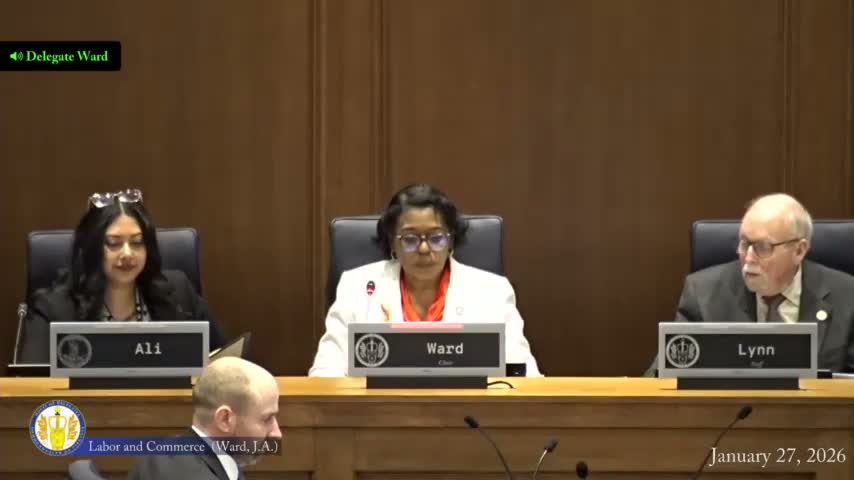
Summary
The Committee on Labor and Commerce received subcommittee reports and voted to report or refer a slate of labor and energy bills, including paid sick leave expansion (HB 5), a farmworker minimum-wage change (HB 20), HB 130 (workers' compensation presumption) and multiple utility-related measures. Several measures were referred to Appropriations.
The Committee on Labor and Commerce heard subcommittee reports and voted to report or refer a broad set of labor and utility bills to the next stages of the General Assembly process.
An administrative action removed HB 827 from the docket at the request of its patron. Subcommittee 2 reported a series of labor and compensation bills, including HB 5 (paid sick leave expansion), which the subcommittee recommended with amendments and the full committee reported with an amendment by a recorded vote announced in committee as 15 to 7. HB 20, a bill to remove certain exemptions for farm laborers and some temporary foreign workers from Virginia’s minimum-wage law, was reported to Appropriations after a committee vote announced as 14 to 8.
The committee also reported HP 27, extending overtime protections to certain domestic workers with a delayed effective date of July 1, 2027 (committee report announced 15 to 7). HB 130, expanding a workers’ compensation presumption for certain cancers to include sheriffs and deputy sheriffs, passed the committee 22 to 0 and will be referred to Appropriations. HB 238 (wage/overtime/misclassification enforcement) was reported with a substitute (reported 15 to 7). Consumer-protection measures, including HB 312 concerning motor vehicle glass repair and HB 426 addressing employer offsets in workers' compensation recoveries, were reported (HB 312 and HB 426 recorded as 22 to 0 in committee). Subcommittee 2 also reported a bill to authorize administrative expenses for the Uninsured Employers’ Fund; the committee reported it 22 to 0.
Subcommittee 3 recommended reporting several energy and utility-related bills. HB 84, requiring certain utilities to file annual reports with the State Corporation Commission (SCC) about RTO voting and stakeholder actions, was reported with a substitute excluding cooperatives. HB 114 (infrastructure analysis) was reported with a substitute directing the Department of Energy to analyze existing utility infrastructure alternatives and was passed 22 to 0. HB 120 (creating a public utility ombudsman role in the SCC’s consumer services section as a substitute) was reported and referred to the Appropriations Committee per counsel’s guidance (transcript reports the committee vote as 18 to 0). HP 434, directing Dominion and Appalachian Power to petition the FCC on grid-utilization metrics and asking the FCC to analyze non-wires alternatives, was reported 22 to 0. HP 492, concerning utility tree-trimming in public parks, was reported as amended after debate and an on-the-floor re-check of the subcommittee vote; the committee recorded the final vote as 13 to 9. HB 562, allowing electric cooperatives to implement virtual power plant programs and offer incentives for customer battery storage, was reported 22 to 0.
Votes at a glance: HB 827 — stricken from docket (motion passed; transcript vote language unclear); HB 5 — reported with amendments (committee announced 15 to 7); HB 20 — reported to Appropriations (committee announced 14 to 8); HP 27 — reported with amendments (15 to 7); HB 130 — passed and referred to Appropriations (22 to 0); HB 238 — reported with substitute (15 to 7); HB 312 — reported with substitute (22 to 0); HB 339 — reported with substitute (15 to 7); HB 426 — reported with amendments (22 to 0); Uninsured Employers Fund bill — reported (22 to 0); HB 84 — reported with substitute (tally not completely clear in transcript); HB 114 — reported with substitute (22 to 0); HB 120 — reported and referred to Appropriations (18 to 0); HP 434 — reported with substitute (22 to 0); HP 492 — reported as amended (13 to 9); HB 562 — reported (22 to 0).
Committee members and presenters repeatedly reminded members that the full committee will not accept new amendments or substitutes and urged that amendments be handled in subcommittees or on the House floor to keep the calendar moving. Several instances in the record show committee clerks and counsel clarifying subcommittee vote tallies and counsel advising referral to Appropriations where required.
Next steps: Most reported bills will move to Appropriations or the next committee in the process; committee staff will carry reported substitutes and documentation forward according to House rules.