
Subcommittee backs substitute for bill directing VDOT to report on invasive plants along highways
Get AI-powered insights, summaries, and transcripts
Subscribe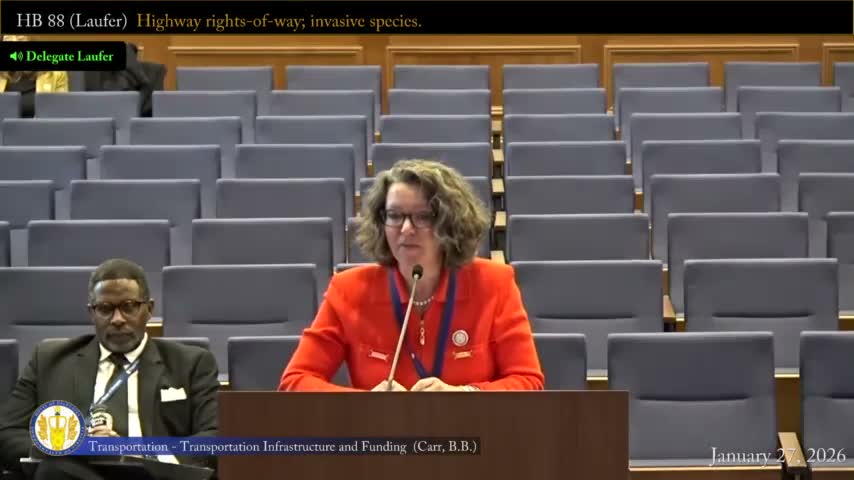
Summary
A House transportation subcommittee reported a substitute for HB 88 that would require the Department of Transportation to study and report by Dec. 1, 2026, on options to expand management of invasive plant species on state rights of way; environmental groups supported the measure while VDOT said resource needs are uncertain.
A House transportation subcommittee on Jan. 28 reported a substitute to HB 88 that would direct the Virginia Department of Transportation to develop a report to the chairs of the House and Senate transportation committees by Dec. 1, 2026, on how to remove and control invasive plant species along state highways.
Sponsor remarks and supporters: The bill’s sponsor said the substitute would both bar planting certain invasive species along highways and require a VDOT-led study to identify how the department could expand management. Chris Miller of the Piedmont Environmental Council testified in support, calling the bill “a great first step” to address invasives moving along rights of way. Connor Ransom of Environment Virginia and the Virginia League of Conservation Voters described existing statewide coordination efforts including the Virginia Invasive Species Management Plan and urged continued action.
VDOT concerns and fiscal questions: Angel Dean of VDOT told members the department currently prohibits three species along rights of way while the Virginia Department of Conservation and Recreation maintains a list of about 103 invasive species. Dean said VDOT had no firm estimate for the staff time or funding needed to perform the study and “existing resources might be insufficient” but that the department could divert resources if necessary. When asked about fiscal effects, the sponsor acknowledged the measure may need referral to appropriations.
Industry and agricultural input: Caitlin Jordan of the Virginia Farm Bureau supported the bill, citing an estimate that invasive plants cause more than $1,000,000,000 in annual damage in the Commonwealth, and James Hudson of the Virginia Association of Counties also expressed support.
Committee action and next steps: The committee voted to report the substitute and refer it to the Appropriations Committee for consideration of any fiscal implications. The referral means VDOT may be asked to provide cost estimates and the department and DCR would coordinate on the detailed scope of the report.
What’s next: The bill will go to the Appropriations Committee for review of fiscal impacts and may be revised further based on resource estimates from VDOT.