
Finance Committee hears plan to prepare Maryland for longer lives; agency to seek law codifying framework
Get AI-powered insights, summaries, and transcripts
Subscribe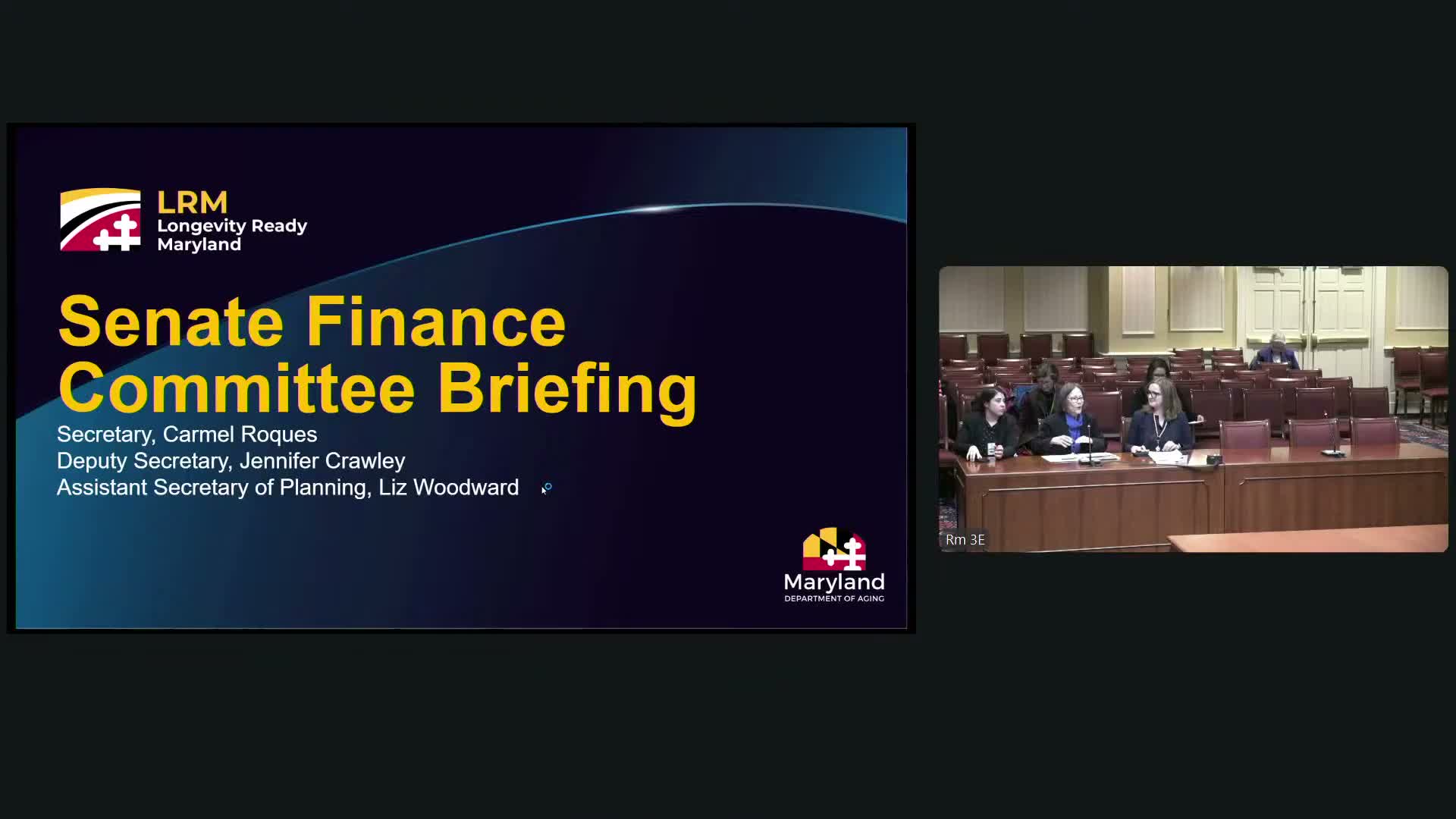
Summary
The Maryland Department of Aging briefed the Finance Committee on its 10-year Longevity Ready Maryland plan and said it will propose legislation to codify the framework; members asked about housing, caregiver supports, workforce strategies and long waiver delays.
ANNAPOLIS — The Finance Committee on Wednesday heard a briefing from Secretary Rokes of the Maryland Department of Aging on "Longevity Ready Maryland," a 10-year, multisector plan the department says will prepare the state for a rapidly aging population.
"Our vision at the Maryland Department of Aging is that every Maryland resident will lead a life that is healthy, financially secure, socially connected, and purposeful across their full lifespan," Secretary Rokes said, outlining the plan's goals and the department's statutory role in distributing and monitoring federal and state grant funding.
The plan combines the federally required four-year state plan on aging with a 10-year multisector strategy, Rokes said, in what the department calls a national first: integrating federal program administration with longer-term state policy, funding and program planning. Rokes described four "epic goals": build a longevity ecosystem linking housing, health care and community services; reframe older adults as economic contributors; strengthen the care workforce; and prepare Marylanders financially for longer lifespans.
Officials cited demographic and program details during the presentation. Rokes said about 2,300,000 Maryland residents are age 50 or older (roughly 37% of the state), and the state expects the 60-plus cohort to reach about one-quarter of the population in coming years. The department noted that roughly 760,000 Marylanders are unpaid caregivers who together provide about 710,000,000 hours of care; the department said 40% of caregivers now perform complex medical tasks often without formal training.
Rokes highlighted ongoing and pilot efforts: Maryland received a $490,000 caregiving strategy grant from the Administration for Community Living to improve awareness of resources, the department directed $220,000 in aging-in-place grants targeted to under-resourced communities, and the pre-Medicaid long-term services program was redesigned into a $20,000,000 SOAR initiative to reach more older people. Rokes also said the department piloted a memory-care family checklist with Johns Hopkins to help caregivers access resources.
The department intends to introduce a "Longevity Ready Maryland" act to codify the framework, Rokes told the committee, proposing a permanent LRM unit within the Department of Aging, expanded advisory roles for the Maryland Commission on Aging and regular public reporting and updates.
Committee members asked how the plan would translate into services. Senator Washington pointed to pending housing bills (SB36 and HB239) and asked whether the measures or other programs would help seniors afford home repairs and modifications. Department staff said DHCD authors the housing bills and recommended Maryland Access Point (MAP) and the statewide 211 service as first points of contact; staff offered to share a concise list of local programs and direct resources for constituents.
Senator Kyle described a constituent kept in a nursing facility while awaiting approval for a community waiver; agency staff explained the Community Options/Cade waiver registry and priority process, noting assessments, eligibility checks and plan approvals can extend timelines and acknowledged room for improvement in reducing wait times.
On workforce concerns, the department said it is coordinating with the labor department and promoting age-friendly employer practices, skills-based hiring and apprenticeship pathways to retain and recruit older workers. Rokes emphasized that many near-term changes rely on better coordination and use of existing programs rather than a large new fiscal commitment; she said the proposed bill would have no direct fiscal impact because it builds on current assets and structures.
The department encouraged committee members to "adopt the longevity lens" when drafting or reviewing legislation and to amplify LRM recommendations across agencies. Rokes said the first annual LRM report had been submitted to the governor's office earlier this month and that the department will return next week with legislation to codify the plan.
The committee did not take formal action on legislation during the briefing. The Finance Committee scheduled additional hearings and logistics were announced before adjournment.