
ODOT warns of decade‑long revenue gap, seeks targeted funding for ports, lake access and transit
Get AI-powered insights, summaries, and transcripts
Subscribe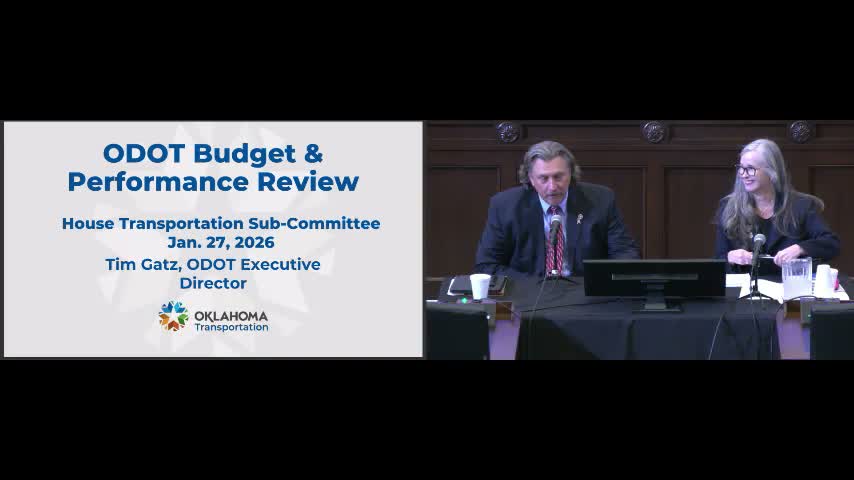
Summary
ODOT Director Gatz told a legislative committee that inflation and declining motor‑fuel revenues threaten the condition of Oklahoma’s highways and bridges and requested targeted funding for ports of entry, lake/industrial access, rural transit mobility management and passenger rail support.
Director Gatz of the Oklahoma Department of Transportation told a legislative committee that recent inflation and long‑term revenue trends are eroding the agency’s buying power and risking deterioration of the state’s highway system.
Gatz said Oklahoma still loses “about 700 or more” residents to traffic fatalities annually and highlighted long‑term progress on bridges, noting that ODOT reduced structurally deficient bridges from nearly 18 percent (about 1,200) two decades ago to “about 35” today. But he warned that declining purchasing power could reverse those gains.
“1 traffic fatality is too many,” Gatz said, framing safety as ODOT’s top priority. He told lawmakers that ODOT has roughly 30,000 lane miles (about 12,200 centerline miles) and 6,800 bridges and that the replacement value of pavements alone is about $107.24 billion; the agency estimates the total highway system replacement value at about $128.26 billion and that the system currently retains roughly 74 percent of its brand‑new value.
On revenues, Gatz said motor‑fuel tax collections still supply just over half of state transportation revenues but are beginning to decline, driven primarily by improved fuel efficiency rather than electric vehicles. He told the committee that current investment levels could cost the state almost $3 billion of system value over the next decade — an annual purchasing‑power gap of roughly $275 million.
Rather than a single large ask, Gatz outlined several targeted requests and priorities for the Legislature’s consideration: preserving the roads fund base (about $610 million), protecting the statutory allocation to roads (ODOT projects roughly $204.5 million), maintaining a $20 million legislative allocation for ports of entry or redirecting weigh‑station revolving fund dollars to that purpose, a $10 million request for lake and industrial access projects, and roughly $2 million to fully fund a mobility‑management pilot for rural transit operators that helps match federal funds.
Gatz also warned the committee that some program accounts can be re‑designated into ODOT’s base, which would reduce the visibility of those dedicated appropriations. He described the ports and weigh‑station conversation as “intuitive” — permit and enforcement fees collected into the Weigh Station Revolving Fund could be a logical source to sustain ports of entry and associated technology.
The director briefed lawmakers on other funds and programs: the Ports and Infrastructure Revolving Fund (the Legislature set aside $16.2 million and ODOT received two applications); a retro fund (ODOT has awarded $229 million of a $400 million total and expects near‑full commitment by October 2027); and the transit revolving fund (about $6.9 million) used by rural operators to match federal grants.
Gatz closed by urging long‑term revenue discussions for highway reauthorization and noting that federal appropriations and the Highway Trust Fund create additional uncertainty for the state’s 8‑year construction plan.
The committee followed with questions on specific projects, program eligibility and fund balances; Gatz offered to provide more granular breakdowns (for example, the composition of weigh‑station receipts and the specific costs of encampment cleanup on rights‑of‑way). The briefing ended with the committee adjourning without any formal vote.
Ending: The committee received ODOT’s detailed budget and condition briefing and signaled follow‑up requests for finer fiscal breakdowns; lawmakers will consider ODOT’s targeted asks as part of the larger state budget process.