Get Full Government Meeting Transcripts, Videos, & Alerts Forever!
Get email alerts on the Strangulation Suffocation topic
No spam. Unsubscribe anytime.
Abuse commission urges separate strangulation and suffocation offenses; committee tables work session for more stakeholder input
Summary
Maine’s abuse commission recommended moving strangulation out of the aggravated‑assault paragraph into its own subsection and explicitly codifying suffocation to improve jury instructions, data collection and victim response; prosecutors supported clarity but opposed elevating the felony class to A; the committee tabled further action to allow language drafting and stakeholder review.
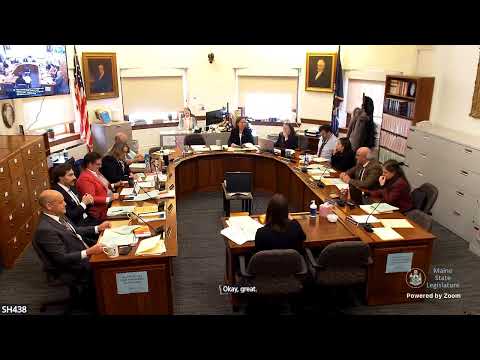
The Maine Commission on Domestic and Sexual Abuse told the Joint Judiciary Committee that creating distinct statutory language for strangulation and for suffocation would improve jury instructions, enable consistent data collection and strengthen responses for survivors.
Andrea Mancuso of the Maine Coalition to End Domestic Violence, chair of the action group, said the commission reviewed other states’ statutes and found that separating strangulation into its own paragraph and adding an explicit definition of suffocation would allow the criminal legal system to better identify and track these offenses. "The abuse commission is recommending that strangulation be separated in the aggravated assault statute to keep it in the aggravated assault statute, but to drop it into its own paragraph, to allow for better jury instructions and data collection," she said.
The action group proposed statutory language that would keep strangulation as aggravated assault but list it in a specific subsection and add a separate subsection for suffocation, defined to include impeding breathing or circulation by applying pressure to the chest or blocking the nose and mouth.
Prosecutors supported clarifying the statute and simplifying jury instructions but counseled caution about raising the offense level. Shira Burns of the Maine Prosecutors Association, a trainer and former frontline prosecutor, said the changes were intended to "clarify, simplify" without altering substantive law and warned that moving the offense to a class A would be problematic: "At this point, I would not be in favor of a class a." Burns explained that higher classes can complicate plea negotiations and could reduce the number of convictions achieved in practice.
The action group also recommended a nonstatutory training strategy: encourage multiagency training on strangulation and suffocation by 2030 (law enforcement, prosecutors, judicial officers, EMS, medical providers and advocates) rather than impose an unfunded statutory mandate.
After hearing from the commission, prosecutors and committee members, several lawmakers said they wanted additional stakeholder input and time to review drafted language. The sponsor and staff offered three options: vote now, ask staff to draft amendments and hold a follow‑up work session with invited stakeholders, or seek an extension of the committee deadline. The committee voted to table further action on LD 1572 and directed staff to prepare amendment language and schedule additional review.