
Hughes Center urges "climate-smart agriculture" in 13-point road map to help Maryland farmers adapt
Get AI-powered insights, summaries, and transcripts
Subscribe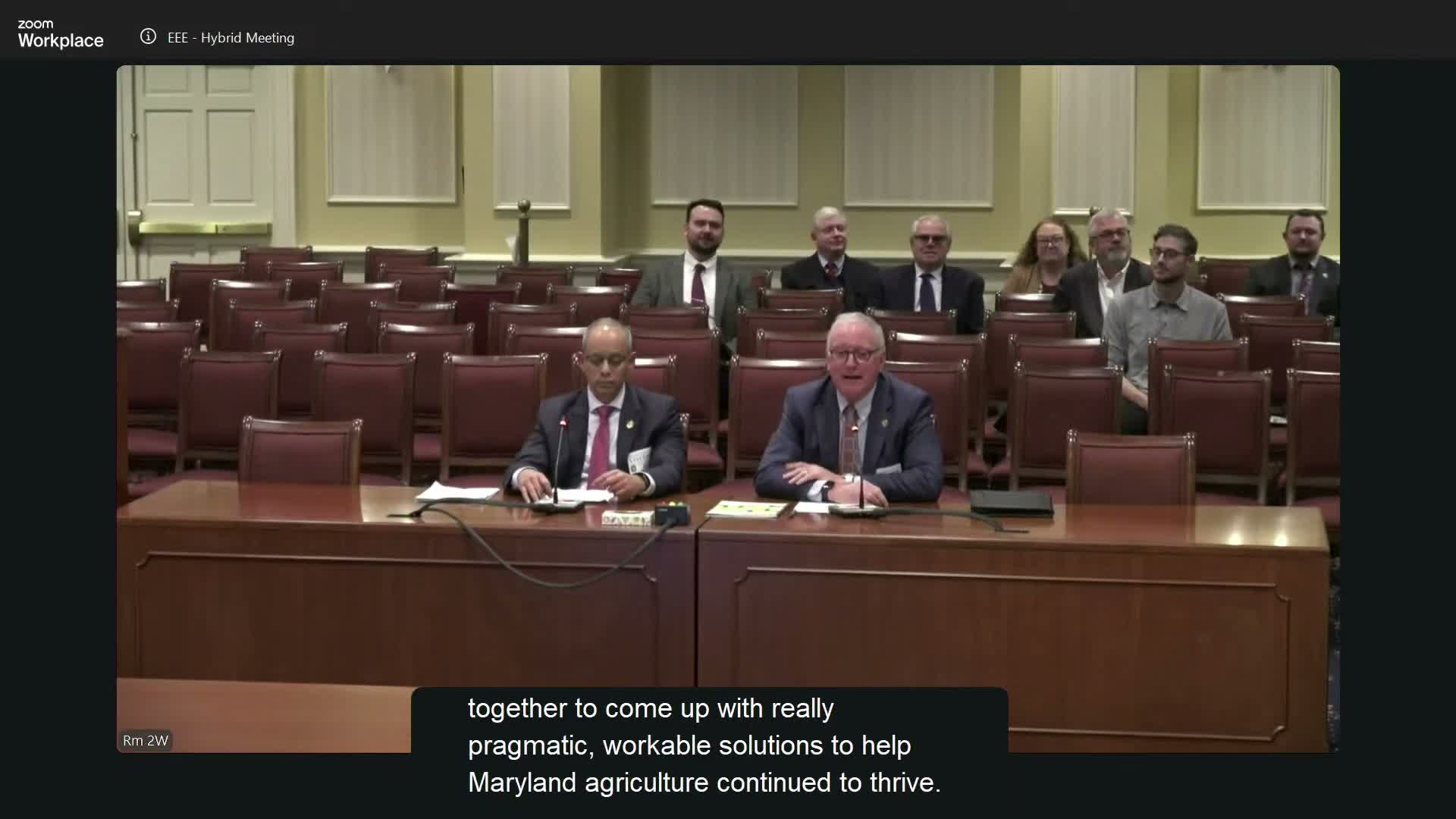
Summary
The Harry Hughes Center presented a 13-recommendation Road Map to Resilience to the Education, Energy, and the Environment Committee, urging Maryland adopt a climate-smart agriculture approach that prioritizes farm economic viability, accelerated adaptation, and integrated land management.
Ernie Shea, vice president of the Harry Hughes Center for Agroecology, told the Education, Energy, and the Environment Committee that his center's Road Map to Resilience "developed 13 key recommendations" intended to help Maryland farmers adapt to changing climatic conditions while remaining economically viable.
The briefing, delivered to committee chair and members, said the road map was developed by a multi-stakeholder team of farmers, state agencies, university researchers and conservation partners and grounded in both long-term research and farmer listening sessions. "Climate change is real," Shea said; "Climate change is happening now and it's going to be a continuing threat multiplier to the future of the state's number one commercial industry." He asked policymakers to "embrace and adopt a climate smart agriculture approach" that leads with measures to keep farms profitable, then emphasizes adaptation and emissions co-benefits.
Puneesh Srivastava, associate dean for research and associate director of the Maryland Agricultural Experiment Station at the University of Maryland, described the scientific foundation for the report and the role of University of Maryland Extension in translating research to practice. Srivastava told the committee that impacts will vary across the state: "Here, what we might experience is sea level rise and salt water intrusion on our coast," and "in Western Maryland, we might see drought and flooding event." He characterized the road map as "not a final word, it's a shared foundation" for future work.
The report highlights two capstone themes: (1) a three-pillar climate-smart approach that starts with farmer economic viability, then accelerates adaptive practices and pursues greenhouse gas co-benefits through conservation practices; and (2) improved integration of land-management planning so food production, conservation, habitat and clean-energy siting are pursued in ways that avoid unintended trade-offs.
Committee members asked about implementation pathways. In response to a question about whether existing agriculture law offers a vehicle, Shea said there is "no one policy" but rather a toolbox that can include zoning, investment, tax policy, conservation programs and agency coordination; he noted collaboration with state leadership including Secretary Addicks and Assistant Secretary Hans Schmidt.
Lawmakers also pressed for specifics: one speaker noted an existing legislative target that would require schools and universities to buy 30% local food, but said the procurement goal has not been realized and that farmers need cold storage and processing infrastructure to meet such demand. Senator Carozza asked the panel to clarify recommendations on updating best management practices, conserving agricultural land amid increased solar siting, and developing farmer insurance tied to climate-driven yield losses. Srivastava described recommendation 13 as research to translate projected climate impacts into insurance products that would compensate farmers for climate-related losses.
The Hughes Center framed the road map as consensus-driven, citing endorsements from a range of stakeholders including the Maryland Rural Council, the Chesapeake Bay Foundation and the Chesapeake Bay Commission. The committee did not take any formal votes at the briefing; the session ended with the chair thanking the presenters and announcing a five-minute break before the next item.
Next steps: the road map was left with the committee for review. Presenters invited follow-up meetings and questions; no formal committee action or statutory proposal was recorded during the briefing.