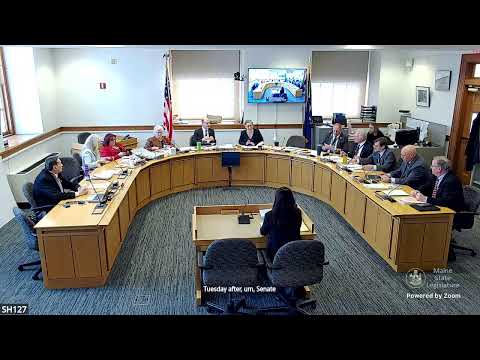
Taxation committee leans against mandatory worldwide combined reporting amid administrative and fiscal uncertainty
Loading...
Summary
Committee discussion of LD1939 (mandatory worldwide combined reporting for unitary businesses with $1B+ revenue) highlighted MRS concerns about administrative capacity and data uncertainty; after analyst and MRS testimony the committee voted an 'ought not to pass' recommendation, while the bill sponsor offered a minority report seeking amendments and a fiscal note.
The Joint Standing Committee on Taxation debated LD1939, a proposal to require mandatory worldwide combined reporting (WWCR) for unitary businesses with more than $1 billion in global gross revenues.
OPLA analyst Jessica Griswold summarized the bill and testimony received during the public hearing, noting that WWCR would require large multinational groups to file combined returns reporting worldwide profits and sales and that Maine currently uses a water's-edge approach with GILTI conformity. Griswold flagged that MRS and other commenters raised concerns about administrability, the need to amend Title 36, Part 8, and the lack of a preliminary fiscal impact statement from OFPR.
Deputy tax policy counsel Daniel D'Alessandro of Maine Revenue Services told the committee a final fiscal analysis is incomplete and WWCR "could be either revenue neutral... lose money or it could gain money" but that any change would likely be modest. D'Alessandro emphasized implementation complexity, including verifying foreign tax and accounting treatments: "We don't have experts in Italian tax law. We don't have experts in Chinese tax law." He added prior estimates that suggested large revenue gains were based on conditions predating the TCJA and GILTI.
Supporters—citing analyses from the Maine Center for Economic Policy and national budget groups—argued mandatory WWCR would reduce profit shifting and help ensure multinationals pay their fair share in Maine. Opponents, including MRS and the Maine Policy Institute, warned that mandatory WWCR could increase compliance costs for taxpayers and administration costs for the state and might make Maine an outlier among states (Alaska is the only state with mandatory WWCR but only for oil and gas).
Senator Bickford moved 'ought not to pass' on LD1939; after caucusing and further debate the committee recorded a majority 'ought not to pass' recommendation, with Representative Matlack filing a minority report stating the bill 'ought to pass as amended' contingent on a fiscal note and statutory changes to Title 36, Part 8.
Committee members asked MRS to provide additional detailed fiscal analysis and workload estimates; the taxation committee left the matter open for further analytical work and potential amendment.