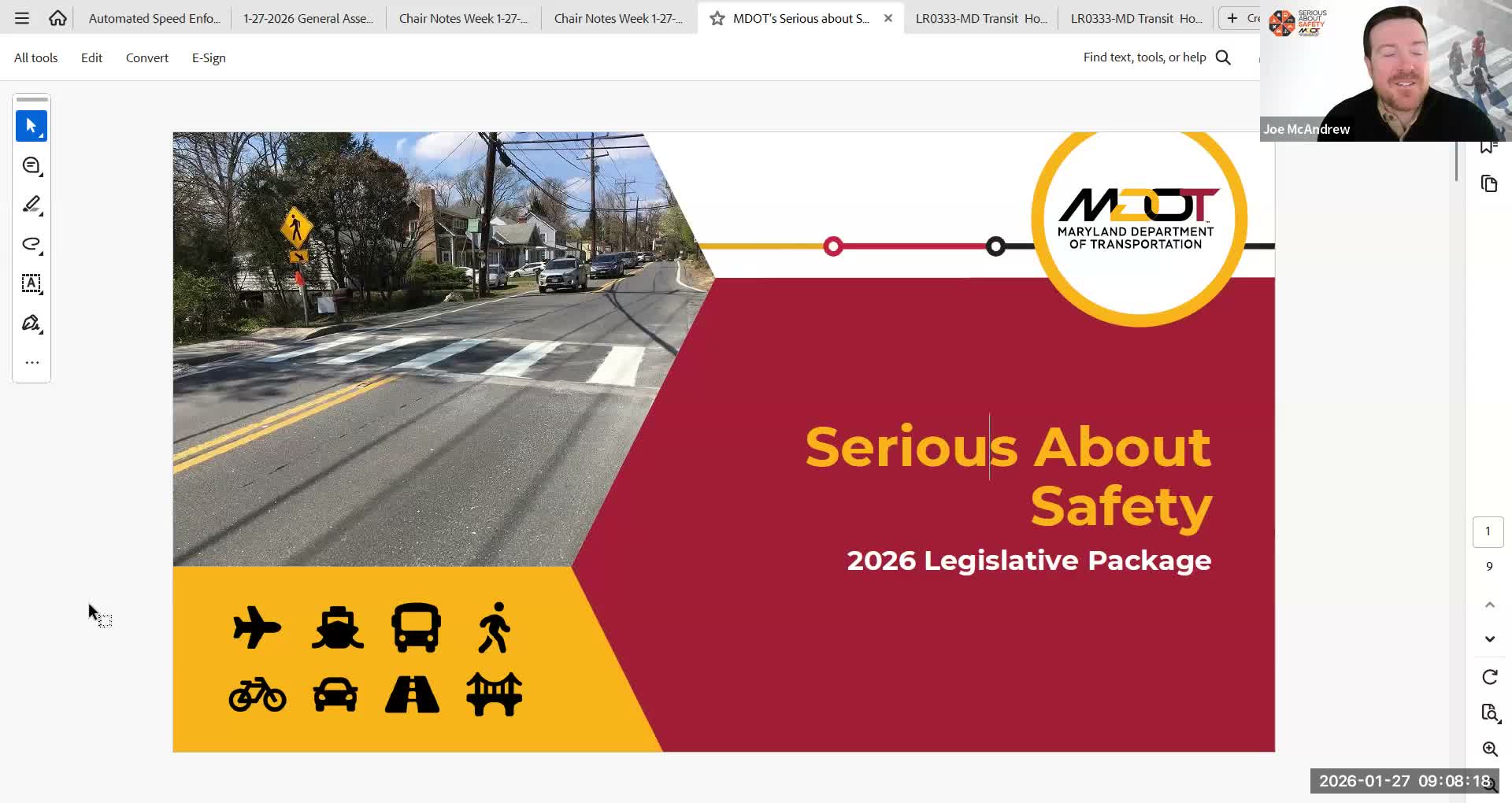
MDOT asks Prince George’s County council to back three safety bills, including automated enforcement reciprocity
Loading...
Summary
Maryland Department of Transportation briefed the General Assembly Committee on three safety-focused bills — automated enforcement reciprocity, automated speed enforcement in vulnerable‑user corridors, and an easier path into ignition interlock — and asked for county support and clarifying dialogue on implementation details.
The Maryland Department of Transportation told the Prince George’s County General Assembly Committee on Jan. 27 that it is seeking new legislative tools to reduce roadway fatalities and asked the council to support three bills that MDOT says are central to that effort.
Joe McAndrew, MDOT assistant secretary, said the agency is pursuing a “Vision Zero” goal of zero roadway fatalities by 2030 and described a roughly 18% reduction in fatalities from 2024 to 2025, while noting the state still records “nearly 400 or 500 deaths” annually. He said the three bills would modernize enforcement tools, enable proven countermeasures and expand access to safety programs.
MDOT outlined three priorities: (1) a reciprocity bill to let Maryland enter reciprocal agreements with other jurisdictions to enforce automated traffic citations issued to out‑of‑state registered vehicles; (2) a State Highway Administration bill to authorize automated speed enforcement in data‑identified Vulnerable Road User (VRU) corridors and clarify local coordination; and (3) a Motor Vehicle Administration proposal to allow certain drivers to enter the ignition‑interlock program without a court‑ordered hearing.
April Moller of the State Highway Administration said the VRU corridor bill would permit SHA to place automated speed cameras on highways identified through a five‑year vulnerable‑user assessment, allow local jurisdictions with active camera programs a first opportunity to operate cameras in a corridor, and align fines and data‑privacy protections with prior legislation. Lisa Nissley of the Motor Vehicle Administration described the ignition‑interlock change as a process improvement intended to lower burdens on courts and increase participation by drivers who violate alcohol‑related license restrictions.
McAndrew said MDOT would model revenue handling for automated enforcement on existing citation reciprocal agreements and emphasized that MDOT’s stated priority is safety rather than revenue generation: “We’re really focused on the action, the infraction, and trying to mitigate that from happening. If revenue is generated, we try to reinvest that then into our safety programs.”
Committee members asked for clarifications about revenue allocation, whether reciprocity agreements would be prospective or retroactive, and how penalties from private toll operators compare across jurisdictions. MDOT staff said they would provide follow‑up answers and noted ongoing conversations with the Maryland Association of Counties and neighboring states.
The committee did not take a formal vote on the MDOT package at the Jan. 27 meeting; MDOT requested the council’s consideration and said it will return with additional information and coordination requests in the coming weeks.