Committee advances consumer-protection bill for virtual-currency kiosks; debate centers on transaction caps and receipts
Loading...
Summary
HB 505 would require fraud warnings, transaction limits, printed and electronic receipts, and refund policies for virtual-currency kiosks. Industry witnesses supported many provisions but warned low transaction caps could threaten business; AARP and elder advocates urged stronger consumer protections. The committee adopted amendments and reported the bill favorably.
Representative Owens explained HB 505, describing virtual-currency kiosks (VCKs) as devices often located in convenience stores that allow cash-for-cryptocurrency purchases and have been used in elder-financial-exploitation schemes. "The operators are not the bad guys," Owens said, but he argued kiosks have been used to defraud seniors and proposed mandatory fraud warnings, daily transaction limits, detailed receipts, and a refund policy.
The sponsor offered a strike-all amendment to give enforcement authority to the Office of Financial Regulation (OFR), change the refund requirement from the entire first transaction to refund of transaction fees obtained and set an effective date of July 1, 2026. Representative McFarland offered an amendment to the amendment that lowered suggested caps ($500 for new customers, $1,000 for existing customers), required printed receipts in addition to electronic receipts, added an email and website on receipts for refund requests, and lowered documentary requirements for consumer refund claims from notarized affidavits to law-enforcement case numbers.
Sean Stafford (quoting a client for Bitcoin Depot) praised many anti-fraud features but warned that the proposed $500/$1,000 thresholds could "completely shut them out of business" in Florida; he said many kiosks already have pop-up warnings and other safeguards and noted transactions above $10,000 already trigger federal reporting. AARP's Karen Murillo and other elder-advocacy witnesses urged printed receipts and lower caps, citing multi-million-dollar losses by Floridians from crypto-ATM scams and the disproportionate impact on older adults. "We're seeing numbers in over $3,030,000,000 dollars that has been lost by Floridians from crypto ATM scams alone," Murillo said.
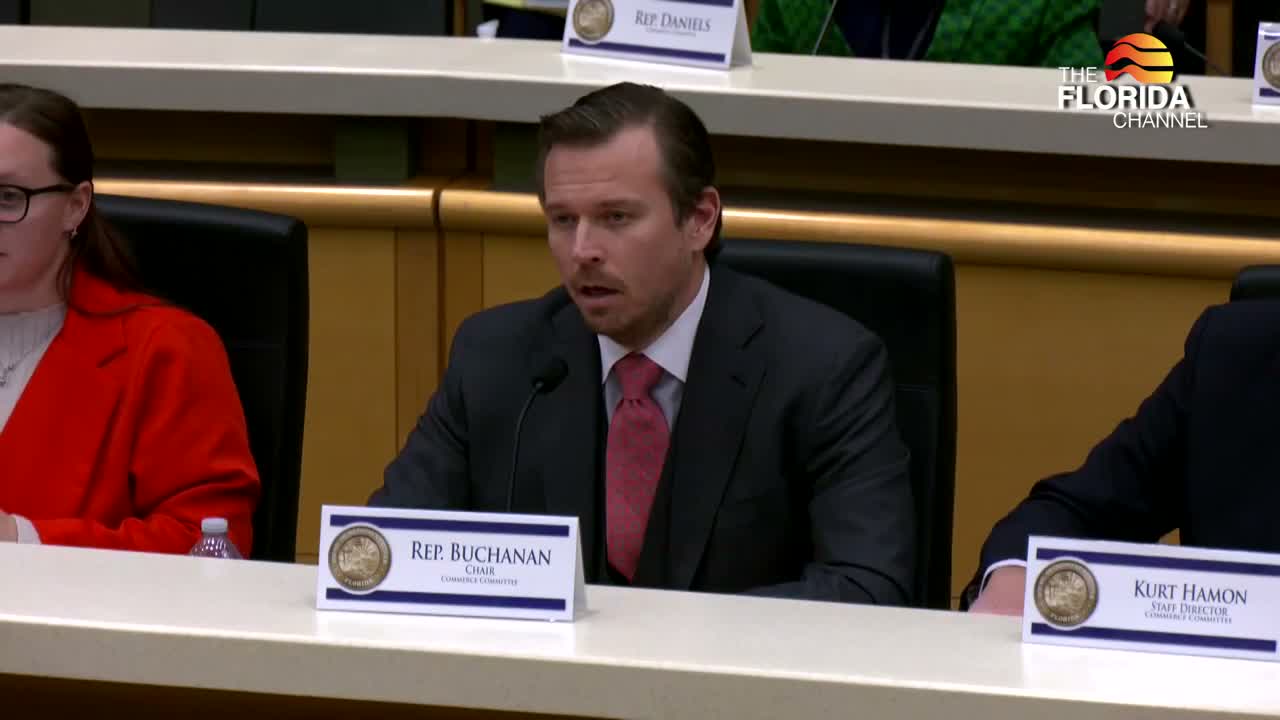
Committee members discussed tradeoffs between consumer protections and business impacts. Representative McFarland emphasized local law-enforcement experience showing most fraud occurs on first transactions and urged the lower caps and printed receipts as meaningful protections. The committee adopted McFarland’s amendment to the amendment, adopted the strike-all amendment as amended, and then reported HB 505 favorably after additional testimony from financial-industry witnesses who supported anti-fraud measures.
The bill proceeds with committee recommendation; the effective date in the amendment is July 1, 2026.