Get Full Government Meeting Transcripts, Videos, & Alerts Forever!
Get email alerts on the Local Finance topic
No spam. Unsubscribe anytime.
State budget shifts costs to local governments and uses one‑time transfers to balance FY27
Summary
Legislative Services briefed the committee that the governor’s FY27 plan shifts roughly $39 million of retirement cost growth to localities, freezes some aid programs (notably disparity grants), and uses transfers from reserve accounts and the fiscal responsibility fund to balance the year.
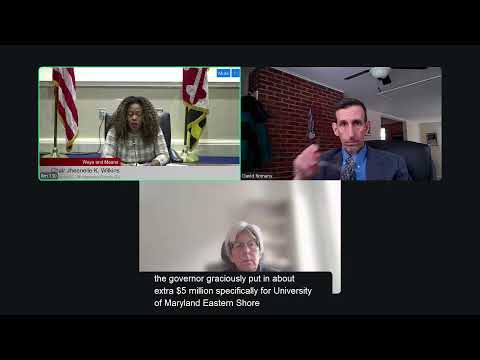
The Department of Legislative Services told the Ways and Means Committee that the governor’s FY27 budget relies heavily on transfers and cost shifts that affect counties and local school systems.
“Local governments cover 50% of the increase in retirement costs that the state would normally cover,” David Romans said, describing a $39 million cost shift to localities for K‑12 teacher and community college retirement growth. Romans said this is in addition to roughly $100 million of similar cost shifts enacted in a prior session.
DLS identified a pause in growth for some local aid lines. The disparity grant is level‑funded at the FY26 formula rather than growing as previously scheduled; Romans said that change reduces support to certain counties, estimating Prince George’s County would lose about $17.5 million and Allegany County about $6 million under the proposal.
Committee members also questioned transfers used to close the FY27 gap. Delegate Buckle asked about a $150 million transfer from the local income tax reserve account and a $187.6 million transfer from the fiscal responsibility fund. Romans explained the local income tax reserve corrects an over‑allocation to counties the state made at the end of FY25, and the fiscal responsibility fund — which received capital‑gains over‑attainment by statute — is being proposed for use in the general fund this year instead of for capital projects.
On capital treatment, Romans said the governor plans to fund a required $167 million WMATA capital amount with general obligation bonds this year rather than with general fund cash, which conserves operating cash at the expense of bond capacity.
Those changes prompted questions from committee members about statutory commitments (for example, rainy day fund appropriation requirements) and whether the use of one‑time transfers masks underlying structural gaps.
The committee asked DLS to provide follow‑up detail on the sources and mechanics of the transfers so legislators can evaluate the impact on local governments before final budget actions.