
Comptroller Outlines Modernization Push and Compliance Programs, Seeks More Staff for Taxpayer Services
Get AI-powered insights, summaries, and transcripts
Subscribe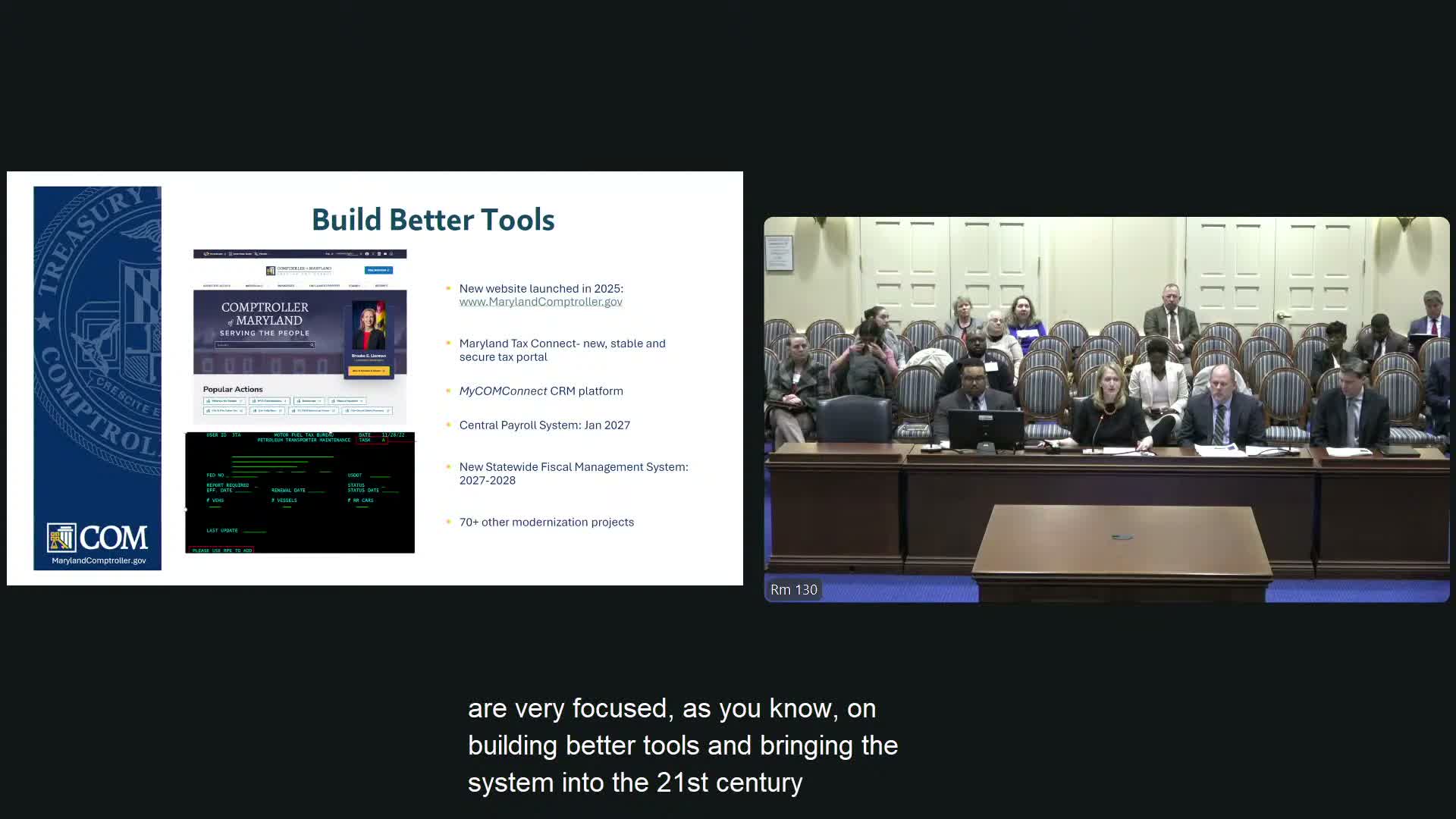
Summary
Comptroller Brooke Lierman briefed delegates on Maryland Tax Connect rollout, a new unclaimed property system, CRM implementation, digital discovery and other compliance tools, and requested additional staffing to improve call and branch service.
Comptroller Brooke Lierman told the Ways and Means Committee the comptroller’s office is pursuing broad IT modernization and compliance expansions intended to improve service and increase voluntary compliance.
“We've launched Maryland Tax Connect, a new stable and secure tax portal for our businesses in February 2024,” Lierman said, and the office plans to migrate personal tax filings to Maryland Tax Connect in August. She described other modernization steps: a new CRM platform, a central payroll system planned for next January, and a new website.
Lierman highlighted a new unclaimed property system launched in October intended to make it easier for residents to search and claim funds, and said the office has created a small policy research shop to publish economic reports and bring more data online through dashboards.
Chief Deputy Comptroller Andy Schoffel reviewed compliance and collections work, telling the committee the office net-collected about $36,200,000,000 in fiscal 2025 and distributes funds to counties and municipalities (he cited $8.5 billion to counties and $204,000,000 to municipal governments). Schoffel and Lierman described three compliance projects—digital discovery to find online reporting gaps, a remote-sellers initiative after Wayfair, and intelligent mail barcoding to improve mailing accuracy—and estimated barcoding could generate roughly $3,000,000 a year.
The comptroller said the General Assembly funded additional staffing and IT investments intended to broaden compliance. “In November 2024, we estimated the net additional revenue gain from these investments in both staffing and technology would be ... 5,100,000.0 FY25, 19,000,000 in FY26, and 37,000,000 in FY27,” Lierman told the committee, and staff said they are on target so far. Lierman said the office requested 129 new PINs last year to boost call-center capacity but received 25; she asked the legislature to consider additional positions to raise phone-answering capacity and reduce in-person walk-ins.
Members asked about bias risks in automated audit models and whether low-income filers could be disproportionately targeted; Lierman and Schoffel said models target nonreporting online activity and that the office analyzes model outputs and does not rely on opaque "black box" systems. Delegates also asked the office to research how bullion sales are coded and whether bullion sales are separately identifiable in tax records; staff agreed to follow up.
Staff said the office will build a state free-filing option as federal Direct File ended, and promised to provide the committee requested operational data (call-volume trends, branch visits and specific tax-code queries) after the briefing.