
Commission to recommend probationary interventions for two priority schools under new state tiering
Get AI-powered insights, summaries, and transcripts
Sign Up Free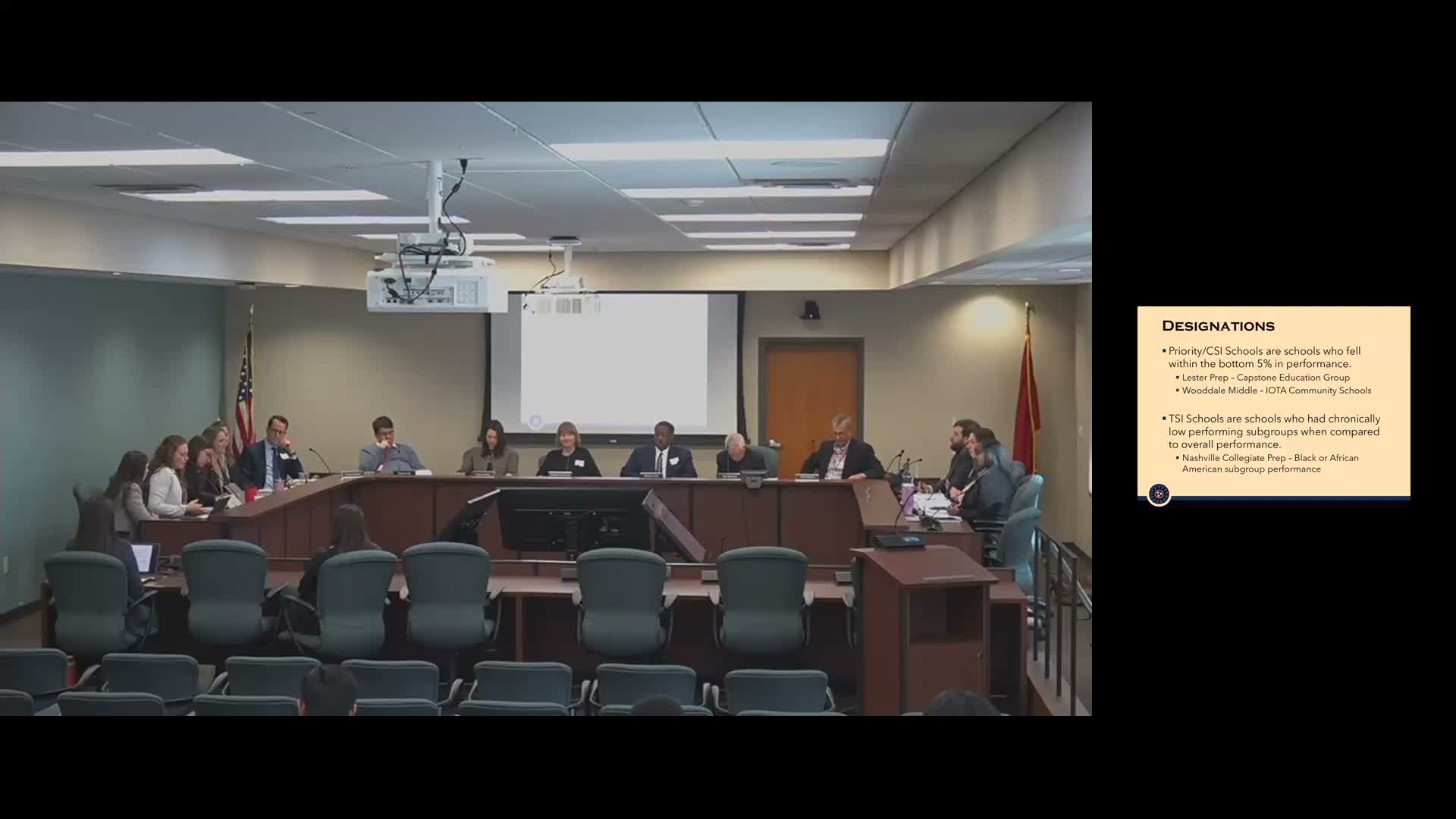
Summary
Following state-designated priority placements, the commission will recommend placing Lester Prep (tier 1) and Wood Dale Middle School (tier 2) on probationary interventions. For Wood Dale the commission selected a department-approved turnaround-expert partnership as the intervention path; for Lester Prep staff will pursue an LEA-led option consistent with tier 1 allowances.
NASHVILLE — Commission staff told the School Performance & Accountability Committee on Jan. 22 that new statutory tiered requirements from the Tennessee Department of Education will require more prescriptive supports for schools designated as priority. Claire Seguin and Dr. Maggie Lund explained how those requirements apply to commission-authorized schools and outlined next steps for two affected schools.
Seguin said the State Board’s priority-school list placed Lester Prep in tier 1 and Wood Dale Middle School in tier 2. "As required under public chapter number 464, beginning with the list of priority schools generated this year, the commission shall develop a comprehensive and progressive support to each of the schools based on the priority school designation," Seguin said.
Because Wood Dale is a tier 2 priority school, the department’s framework requires an intervention that includes a department-approved turnaround expert. The commission selected the option to partner with a turnaround expert for Wood Dale and is interviewing the vetted providers provided by the department; the LEA (school district) retains final selection of the vendor. For Lester Prep, as a tier 1 school, staff said they would pursue an LEA-led intervention aligned to the commission’s plan-of-correction approach.
Commissioners questioned why staffing changes that preceded formal designation could not be credited toward the intervention and criticized the timing of state data releases that delay designations. Staff responded that the department did not allow staffing changes made before an official designation to count toward required interventions and that priority designations are generated on a three-year cycle tied to available assessment data. Staff said they will present a recommendation to place both schools on probationary (level 3) status at the full commission meeting for a vote.
The commission will solidify intervention selections by Feb. 13 and begin coordination on intervention committees, on-site learning-walks, department-required data submissions, and grant budget development tied to improvement funds.