Get Full Government Meeting Transcripts, Videos, & Alerts Forever!
Get email alerts on the Budget Overview topic
No spam. Unsubscribe anytime.
Fairfax City reviews five FY26 budget scenarios that trade tax increases for program cuts and fund draws
Summary
City staff presented five alternatives for the proposed FY26 budget showing different combinations of real-estate and meals-tax changes, vacancy and program reductions, and one-time draws on an EDA fund; the manager’s original proposal (9.5¢ on real-estate rate plus meals-tax changes) would balance revenues and expenditures without tapping all reductions.
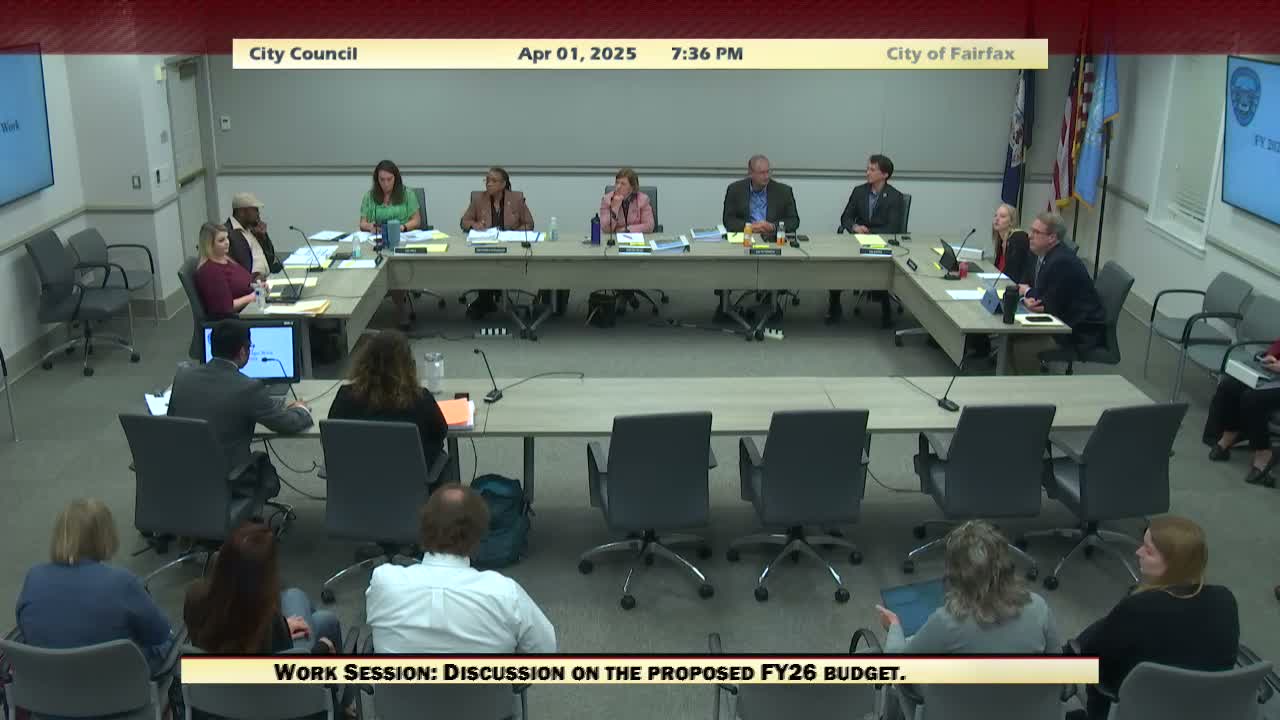
Fairfax City staff on April 1 laid out five concrete alternatives to the manager’s proposed FY26 budget that shift the burden between tax increases, one-time fund draws and program reductions.
Mr. Martinez, the staff presenter, said the starting assumptions "equates to about $190,000,000 in revenues" and that was "about $10,000,000 more than what we had budgeted for FY25." He showed a range of scenarios that combine changes to the real-estate tax rate, adjustments to the meals tax and targeted operating and capital reductions.
Under the city manager’s February proposal (scenario framed as the baseline), the budget included a 9.5¢ real-estate tax increase and an added 2% to the meals tax; Martinez said those changes would generate roughly $8 million and $4.5 million respectively while enabling the city to meet a planned onetime debt payment and other obligations. Alternative scenarios shrink the proposed tax increase and make deeper use of planned vacancy savings, reductions to travel and training, and, in some permutations, a partial recapture of a $5,000,000 transfer to the Economic Development Authority’s real-estate resource fund.
Staff quantified many of the tradeoffs: for example, a scenario with a 7.5¢ increase to the real-estate rate plus a 1.5¢ meals-tax step would net more than $6 million in real-estate revenue and a little over $3.3 million from the meals-tax change, but would require additional use of one-time fund balance and some expenditure reductions.
Department directors walked council through potential CIP deferrals and operating reductions tied to those scenarios, including one-year delays on some parks projects and selective reductions in public-works capital requests that would yield near-term savings but raise long-term maintenance and service risks.
Council members asked staff to provide a clear, consolidated list of all proposed deferments and reductions after the session so members can compare the near-term savings to the deferred costs and service implications. The city manager also reminded the public of a budget open house on April 2 at Sherwood Center for additional outreach and feedback.
The work session produced no final vote; council instructed staff to supply follow-up detail and cost estimates to support upcoming decisions.