Get Full Government Meeting Transcripts, Videos, & Alerts Forever!
Get email alerts on the Environment Urban Forest topic
No spam. Unsubscribe anytime.
Fairfax City outlines urban forest master plan, sets canopy and stewardship goals
Summary
City staff previewed the Urban Forest Master Plan, reporting a 2023 canopy of 37.86%, an invasive-species assessment across 25 sites, and preliminary goals to protect and expand tree canopy, centralize forestry functions, and scale volunteer stewardship.
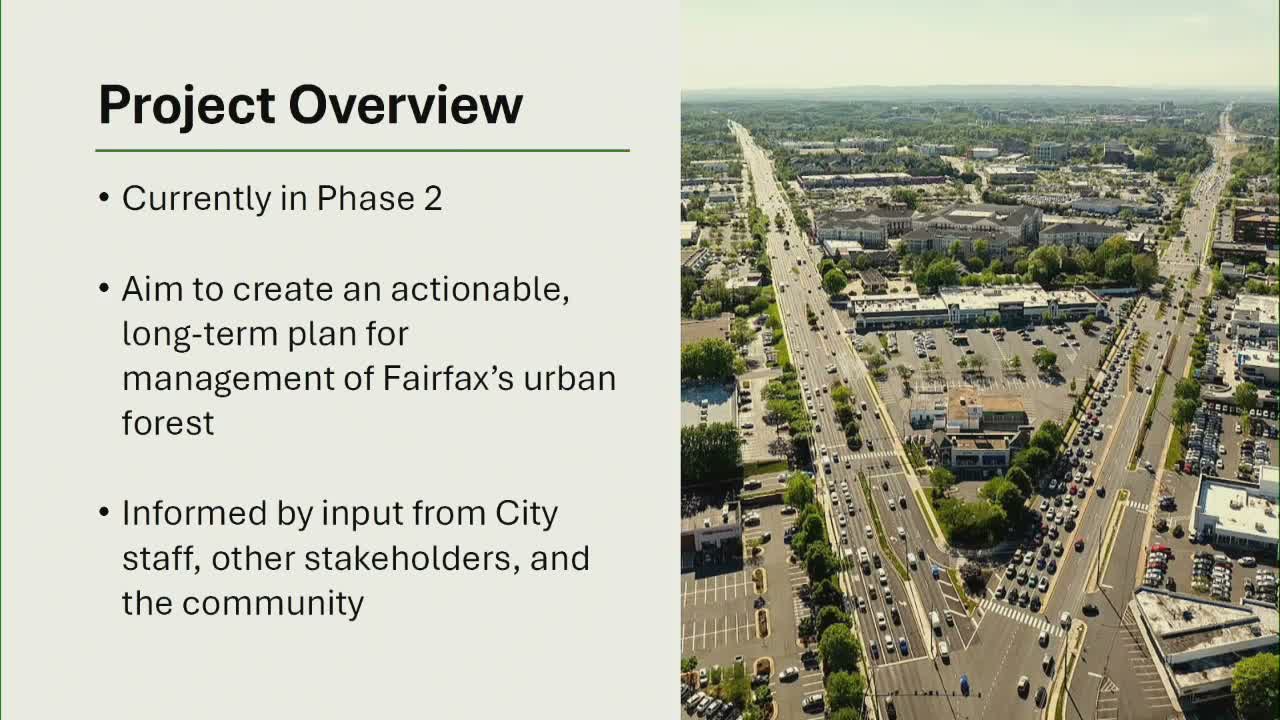
City urban forestry staff presented the preliminary findings and objectives of the Urban Forest Master Plan in a work session briefing that drew council questions about metrics, funding and coordination with parks planning.
Anna Safford, the city’s urban forester, said phase 1 of the plan (outreach and assessment) engaged more than 100 stakeholders and that a 2023 canopy assessment showed 37.86% tree cover citywide. "Tree canopy is not evenly distributed citywide," Safford told the council, and she urged targeted planting and preservation where canopy is low.
Assessment highlights: Staff reviewed operations and budgets (about $700,000 in 2024 across multiple departments), the finding that about 76% of canopy is on private property, and an invasive-species assessment that identified 30 non-native species in 25 sites. Garrett Wolf (consultant) said the highest-ranked site for invasive-species treatment was Kutner Park; the team recommended a mix of mechanical removal, targeted herbicide, and volunteer-driven cultural controls.
Preliminary goals: The UFMP lists three strategic goals — champion and sustain a resilient, equitable urban forest; increase municipal capacity to care for trees; and deepen community stewardship. The plan includes six objectives, such as establishing an urban forestry division, strengthening tree protection policies, improving data and metrics, and expanding volunteer programs such as the Sprout initiative.
Council questions focused on metrics and timing: Councilmembers asked how often canopy mapping is updated (staff said NAIP aerial imagery comes roughly every 2–3 years and jurisdictions often update every 5 years) and whether invasives can inflate canopy figures. Staff said next steps will include public meetings (drop-in session June 11) and a final plan anticipated this fall.
Why it matters: Officials said the UFMP is intended to guide policy and operational changes that will protect mature trees, target planting where canopy is low, and build the city’s capacity to manage public and private trees more effectively.
What’s next: The project will continue public outreach and refine objectives; staff expects a draft for council and public review later this year.