Get Full Government Meeting Transcripts, Videos, & Alerts Forever!
Get email alerts on the Germantown Cemetery topic
No spam. Unsubscribe anytime.
Survey finds Germantown Cemetery eligible for National Register; GPR shows nearly 500 unmarked burials
Summary
Thunderbird Archaeology reported that Germantown Cemetery is potentially eligible for the National Register of Historic Places and that ground‑penetrating radar identified roughly 499 unmarked burials. Staff recommended possible next steps including submitting preliminary information forms to the Virginia Department of Historic Resources and considering local designation routes.
Eric Foreman, senior planner, and consultant Boyd Seif of Thunderbird Archaeology presented an evaluation of five historic properties to the city council on June 3. The presentation highlighted Germantown Cemetery as a site of particular historic and archaeological significance.
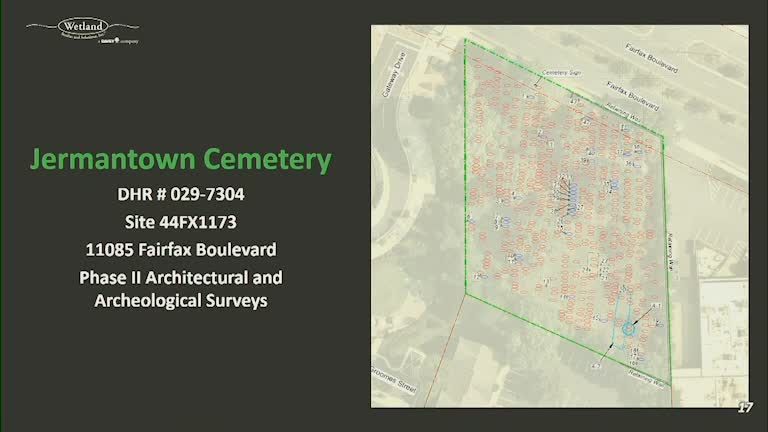
Seif summarized the cemetery work: a ground‑penetrating radar survey and archival research indicate the cemetery was established by 1868 and the GPR results "indicated that there are 499 unmarked burials in the cemetery." The team identified 43 extant headstones naming 51 individuals and noted genealogical research by a local caretaker group indicating roughly 180 individuals believed interred. Based on its age, association with Fairfax's Reconstruction‑era African American community and the potential for archaeological research, the consultant said Germantown Cemetery is "potentially eligible for listing in the National Register of Historic Places under criterion A and criterion D."
The consultants recommended next steps: file a Preliminary Information Form (PIF) with the Virginia Department of Historic Resources (DHR) for properties considered potentially eligible, consider local historic designation processes (which carry separate protections), and coordinate with advocacy groups and the city's boards of architectural review or preservation for outreach and consultation.
Council members expressed strong support for further study and preservation steps. Staff noted that owner consent is required for National Register listing and that listing triggers limited federal review protections for projects involving federal permits or funds; local designation can provide additional protections.