Get Full Government Meeting Transcripts, Videos, & Alerts Forever!
Get email alerts on the Racing Regulation Funding topic
No spam. Unsubscribe anytime.
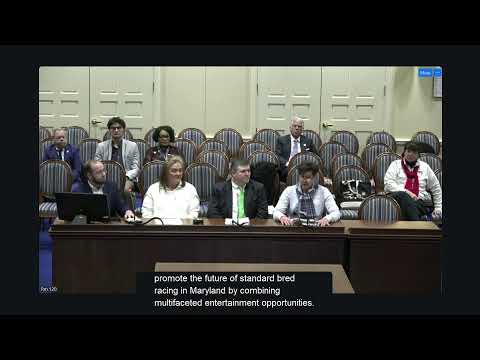
Appropriations Committee hears overview of Maryland racing regulation and funding
Summary
Department of Legislative Services and the Maryland Racing Commission briefed the Appropriations Committee on the industry's history, state funding streams from video lottery terminals, and the commission's regulatory role including licensing and drug testing.
Matthew Bennett, policy analyst with the Department of Legislative Services, told the Appropriations Committee that state oversight of horse racing dates to the early 20th century and that the General Assembly has created dedicated funding streams to support purses and facility renewal. "There's 6% of the gross VLT revenue that is dedicated to the purse dedication account," Bennett said, and that account is split 80% for thoroughbreds and 20% for standardbreds.
Christopher Mertz, executive director of the Maryland Racing Commission, described the commission as a division of the Maryland Department of Labor responsible for regulating pari-mutuel betting and racing operations. He said the commission issues occupational licenses under Title 11 of the Business Regulation Code, conducts pre- and post-race drug testing, investigates violations, and reviews wagering revenue distributions. "We safeguard an industry with an impact of nearly $900,000,000 in the state," Mertz said.
Bennett summarized recent statutory changes and capital plans: the 2020 Racing and Community Development Act authorized redevelopment financing for Pimlico and Laurel and the legislature later adjusted bonding authority figures; Bennett said the statute authorized up to $375,000,000 originally and later references cited bonding authority nearer $400,000,000 while committee members noted total program costs including premiums and interest could appear larger in fiscal summaries.
Why it matters: the purse dedication account and the racetrack facility renewal account are primary mechanisms the state uses to support racing operations, and those streams feed both operational purse payments and long-term facility debt service tied to redevelopment projects. Committee members pressed presenters about how bond premiums and interest affected the program totals and asked where oversight for community amenities sits in relation to those funding commitments.
Next steps: the committee moved on to hear detailed presentations from the Maryland Stadium Authority and the Maryland Economic Development Corporation about redevelopment progress at Pimlico and plans for a training center.