
Merrimack budget committee recommends $96.8 million operating budget after heated public hearing over SEL and program cuts
Get AI-powered insights, summaries, and transcripts
Subscribe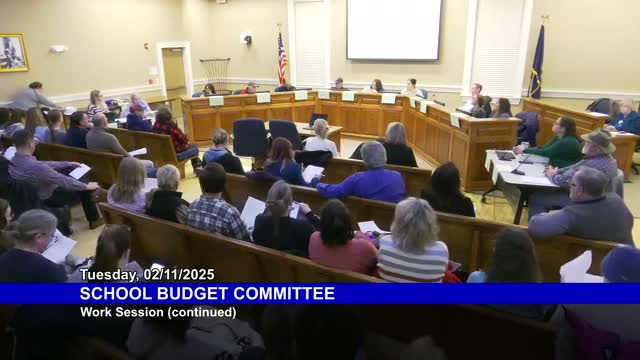
Summary
After more than two hours of public comment, the Merrimack School District budget committee recommended a $96,823,198 operating budget and advanced two money warrant articles — a $500,000 capital reserve fund and an $823,230 roof replacement — while facing sustained demands from parents, teachers and students to preserve social-emotional learning and other programs.
The Merrimack School District budget committee on the evening of the public hearing recommended the district’s proposed $96,823,198 operating budget, after extended public testimony pressing the committee to retain social-emotional learning (SEL), recent curriculum purchases and staffing the district says are required by law.
Committee members and administration repeatedly told the audience the committee’s role is to present a bottom-line number for voters; decisions about program priorities rest with the school board and administration. Matt Chevenell, the district’s business administrator, said the default budget is largely defined by state law and prior commitments: “Default budget as used in this subdivision means the amount of the same appropriations as contained in the operating budget authorized for the previous year reduced and increased in this case…reduced by one-time expenditures contained in the operating budget and by salaries and benefits of positions that have been eliminated,” he said, explaining why large contract and insurance costs limit how much the committee can reduce the default number.
Why it matters: Hundreds of residents and dozens of teachers, paraeducators and students filled the hearing to oppose recommendations from some committee members to trim particular line items. Speakers said such cuts would reverse recent gains and harm vulnerable students. Student Finn Haddad told the committee, “I’m afraid if we turn the default budget over to a committee that works in terms of getting reelected…we’re gonna end up falling below our contractual obligations,” while paraeducator Molly Azatia described classroom impacts if programs and staffing were cut.
What was proposed and why: Committee member Marie summarized several lines the work session discussed removing or trimming to lower the requested operating number: a 5% reduction in supplies (account 8610) amounting to $57,330; $8,000 for a proposed middle-school lacrosse team; three administrative-assistant positions tied to special-education paperwork (approximately $90,000 plus benefits); a proposed Reeds Ferry counselor position (about $100,000 plus benefits); professional-development substitute lines totaling $128,712; $495,607 identified as SEL-related program funding; and a $237,500 one-time purchase of the Wit and Wisdom curriculum. Marie stressed the district must avoid locking in recurring costs under the maintenance-of-effort rule for special education and suggested reallocating existing staff or using overtime to address temporary backlog work.
Supporters’ case: Teachers, parents and students argued those reductions would be harmful. Sarah Leland, a special-education teacher, told the committee she appreciated members who “support public education” and warned that removing SEL funding would jeopardize supports for students with anxiety, trauma and other needs. A number of speakers noted measurable gains on state tests at elementary levels and credited curriculum and staffing investments for the improvements.
Administration response and legal limits: Chevenell and other administrators reminded the committee that certain costs are mandated or contractual. Chevenell identified the Mesa contract increases and a health-insurance rise as major drivers, and said many one-time items were already stripped from the prior-year default. Committee members and administration also discussed NFH administrative rule 306.04 as context for SEL instruction’s delivery and the distinction between curriculum purchases paid from surplus and recurring operating costs.
The vote and next steps: After debate the committee moved to a roll-call vote. The transcript records the committee’s recommendation on the operating budget reported as 8–4–1 in favor of recommending the operating budget as presented to the voters; the committee’s MS-27 form (the report to the Department of Revenue) must be signed by a majority before the statutory deadline. The budget committee also recommended Article 3 — a one-time capital reserve fund up to $500,000 to begin addressing administrative-office and ADA concerns — in a unanimous 13–0–0 vote, and recommended Article 4 — $823,230 for roof replacement at James Mastricola Elementary — also by unanimous roll call.
Votes at a glance: - Article 3 (capital reserve fund up to $500,000) — Motion passed; roll call recorded as recommended by the budget committee, 13–0–0. (Mover: Stewart; roll-call recorded beginning SEG 2523; vote recorded SEG 2560–2562.) - Article 4 (roof replacement at James Mastricola Elementary) — Motion passed; roll call recorded as recommended by the budget committee, 13–0–0. (Motion and discussion SEG 2574–2596; roll-call recorded SEG 2750–2761.) - Article 8 (operating budget $96,823,198; default $95,808,066) — Committee moved to call the vote and the roll call produced a recommendation reported as 8–4–1 in favor of recommending the operating budget to the ballot. (Motion to call vote SEG 3503–3506; roll call and tally discussion SEG 3529–3569.)
What’s next: The committee must complete and sign the MS-27 report to the Department of Revenue by Feb. 20; the articles will appear on the ballot for voter decision. The committee scheduled its next meeting after the town’s deliberative session on March 5.
Context note: Multiple speakers in public comment referenced statewide funding debates, pending state legislation expanding education freedom accounts and concerns about the state’s share of school funding. Committee members repeatedly reminded the audience that the budget committee’s legal role is to present a dollar figure for voters; programmatic decisions are implemented by the school board and administration.
Representative quotes: “I felt that we could comfortably remove 5% of the 8610 account, which amounts to $57,330,” — Marie, budget committee member. “Default budget as used in this subdivision means the amount of the same appropriations as contained in the operating budget authorized for the previous year…reduced by one-time expenditures,” — Matt Chevenell, business administrator. “I’m so proud of all the students and teachers who came up to speak today…Last year we defaulted on our budget and I think it impacted our school community,” — Finn Haddad, Merrimack High School student.
The committee adjourned after completing votes on the money articles and addressing administrative items including the right-to-know update and minutes approval. The operating budget, capital reserve fund and roof warrant articles will be decided by voters at the upcoming election.