
Appropriations subcommittee hears briefing on environmental funds as budget shifts special-fund dollars to general fund
Get AI-powered insights, summaries, and transcripts
Subscribe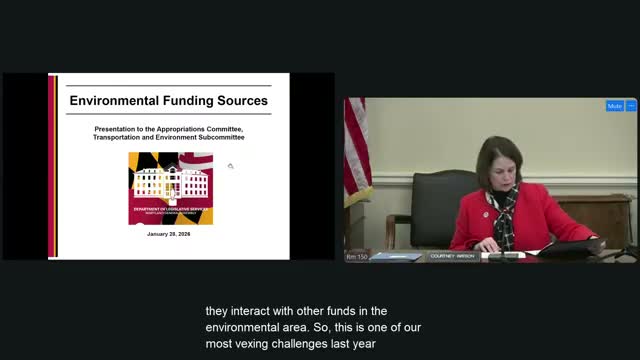
Summary
At a House Appropriations Transportation and the Environment Subcommittee briefing, analyst Andrew Gray outlined four "families" of environmental funding and detailed proposed transfers and bond-based replacements in the governor's budget that would move special-fund dollars into the general fund while seeking to preserve program activities.
At a session of the House Appropriations Transportation and the Environment Subcommittee, members heard a briefing from analyst Andrew Gray on the state's principal environmental funding sources and how the governor's proposed budget would reallocate some special funds to the general fund.
Gray framed environmental funds as four main "families": the Bay Restoration Fund (often called the "flush tax"), the Chesapeake and Atlantic Coastal Bays 2010 Trust Fund (the 20/10 trust), the Strategic Energy Investment Fund (SIF/CEAF) tied to RGGI and alternative compliance payments, and Program Open Space (POS) funded by the state transfer tax. He said the committee reviews operating budget items that last one year, while capital budgets (PAYGO and general-obligation bonds) support multi-year projects and may be used to replace transferred special funds.
Why it matters: the administration's balancing plan for fiscal 2027 includes transfers of special-fund revenue into the general fund and, in some cases, replacing that transfer with bond proceeds in later years. Committee members pressed how those moves affect core environmental programs, long-term maintenance and whether cash balances are already encumbered.
Key items and numbers
- Bay Restoration Fund: Gray described the fund's role financing wastewater treatment upgrades, septic-system support and cover-crop programs. He said households now pay about $60 per year and that rate is scheduled to sunset to $30 per year at the end of fiscal 2030 unless lawmakers act. Gray noted a proposed transfer of roughly $70 million from the fund to the general fund that the administration plans to repay with general-obligation bonds ($50 million in FY27 and $20 million in FY28).
- Repayment risk and constraints: When a member asked whether the state could "renege" on those later-year bond repayments, Gray responded plainly, "You can do whatever you want," emphasizing that repayment and bond issuance are ultimately political and fiscal choices.
- Chesapeake/20/10 Trust Fund: Gray said the fund's revenue sources include a short-term rental/vehicle user tax and a gas-tax component. He warned that declining gas-tax receipts could reduce available funding for cover-crop and nonpoint-source programs, and advised committee analysts to look into multi-year revenue projections.
- Strategic Energy Investment Fund (SIF/CEAF): Gray said RGGI auction proceeds and alternative compliance payments flow to SIF and related accounts. Originally aimed at clean-energy programs, the fund now supports a broader set of items including bill-assistance, housing retrofits and some agency operating costs; Gray noted the FY27 end-of-year balance estimate of about $164 million but cautioned encumbrances and transfers reduce available cash.
- Program Open Space (POS) and transfer-tax allocations: Gray reviewed the POS formula and said the governor's budget proposes a $25 million diversion of transfer-tax proceeds to the general fund (a permanent allocation under current law) and a separate swap that replaces a $71.9 million special-fund transfer with general-obligation bonds in FY27. He showed how transfer-tax revenue is filtered (three percent for administration, adjustments for underattainment, then statutory allocations to state POS, local POS, rural legacy, heritage areas and other line items).
Questions from delegates focused on whether to maintain higher fee levels (for example keeping the $60 Bay Restoration charge instead of letting it revert to $30), how transfers affect competitive grants and operating support, and whether recent high RGGI/ACP receipts are durable. Gray agreed revenue longevity depends on program design and legislation and offered to provide historical POS allocations and further PAYGO analyses.
What the briefing did not include: no formal votes or motions were taken at the subcommittee meeting. Gray deferred some requests for multi-year revenue projections to agency analysts and offered to provide historical allocation tables on POS and CIF upon request.
The subcommittee adjourned after members thanked Gray and asked staff to retain the briefing materials for upcoming hearings with environmental agencies.