Get Full Government Meeting Transcripts, Videos, & Alerts Forever!
Get email alerts on the Public Banking topic
No spam. Unsubscribe anytime.
Senate committee hears wide testimony on proposed Washington public bank; staff flags indeterminate fiscal impact
Summary
Senators heard presentations and extensive public testimony on Senate Bill 5754 to create a Washington State public bank. Presenters cited the Bank of North Dakota and California's municipal work as models; supporters urged passage for infrastructure and disaster finance while county treasurers and community bankers warned of liquidity and constitutional risks.
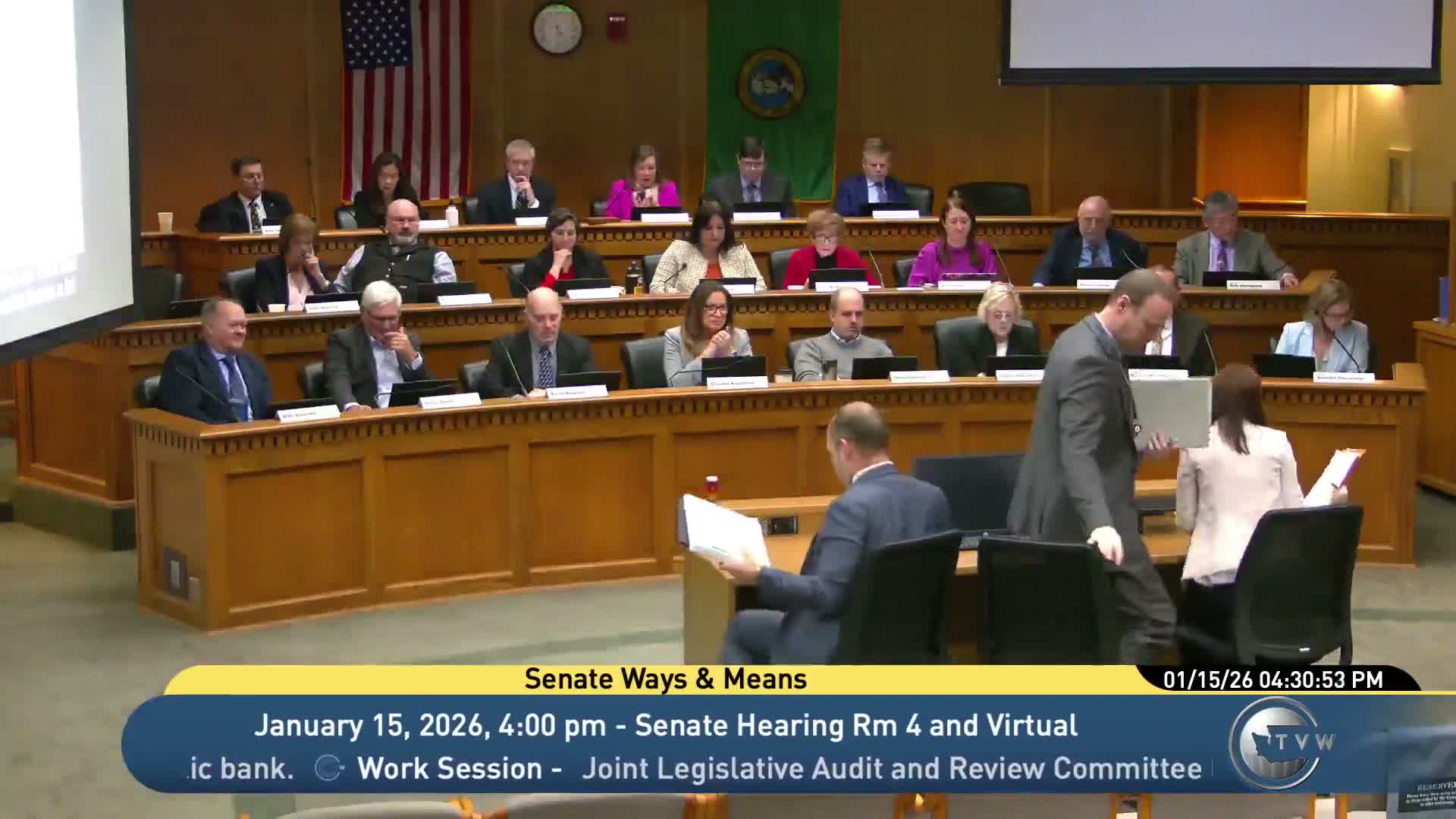
The Senate Ways and Means Committee on Jan. 15 received an overview and public testimony on Senate Bill 5,754, which would create a Washington State public bank and set activation and governance conditions.
Sam Brown, committee staff, described the bill’s central mechanics: activation requires a state appropriation sufficient to support competitively rated debt and execution of articles of activation by the State Finance Committee and member local or tribal governments. Formation would follow approval of articles of activation and member contributions. The bill would create a nine‑member operating board (including three governor‑appointed public directors and the state treasurer as an ex officio member) with authority over budgets, staffing and loan programs; bank obligations would be obligations of the bank, not the state. Brown said fiscal impacts are largely indeterminate and cited prior estimates of startup costs (state treasurer: ~$6 million for initial operations; a 2020 UW business plan estimated a $10 million general‑fund loan for start‑up capitalization).
Advocates presenting remotely described public‑banking models in California and North Dakota and argued a state bank could keep public funds local, lower borrowing costs for infrastructure and housing, and expand financing options for smaller jurisdictions. Trinity Tran of the California Public Banking Alliance summarized California’s framework (feasibility study requirement, DFPI authorization, FDIC insurance) and municipal activity since 2022. Don Morgan, president and CEO of the Bank of North Dakota, joined from North Dakota and said his bank has leveraged approximately $6 billion in state deposits into about $10 billion in total assets and credited the model with helping state disaster response and supporting community lenders.
Senators asked technical and constitutional questions about leverage and restrictions on investing state funds. Morgan described a roughly 1:10 leverage ratio on capital in banking and participation lending with many community institutions; he cited examples of disaster loans and liquidity management in North Dakota.
Public testimony was extensive and split. Supporters included state Superintendent Chris Reykdal, Insurance Commissioner Patty Kuder, Snohomish County Treasurer Brian Sullivan, Whatcom County Executive Satpal Sidhu, mayors and advocacy groups. Their arguments emphasized a financing gap for infrastructure (Sullivan cited a statewide need exceeding $100 billion), the potential to keep interest and fee revenue in-state, and tools for disaster mitigation and community lending. Patty Kuder said the bank would “increase public financing capacity without increasing taxes on Washingtonians or accumulating more state debt.”
Opponents included the Community Bankers of Washington and the Washington State Association of County Treasurers. Brad Tower of the Community Bankers argued in opposition that a public bank “doesn’t work that way,” questioned claims about large multipliers from deposits and warned of liquidity and safety risks for public deposits. County treasurers stressed their fiduciary duties for safety, liquidity and return, and said they had not agreed to deposit public funds into a new, untested entity.
The hearing closed after several hours of testimony; committee members did not take an immediate vote. Staff materials and the bill’s fiscal note were provided to the committee for further review.