Get Full Government Meeting Transcripts, Videos, & Alerts Forever!
Get email alerts on the Retirement Systems topic
No spam. Unsubscribe anytime.
Committee hears agency request bills to align retirement lump‑sum rules and retain interest‑earnings authority
Summary
Staff and agency witnesses told the House Appropriations Committee that House Bills 2124 and 2125 are technical changes to retirement plan administration: HB 2124 raises the minimum monthly benefit eligible for lump‑sum payout from $50 to $250 (adjusted by the director); HB 2125 removes a biennial restriction on using pension‑fund interest for certain administrative costs. Fiscal notes show modest administrative costs and no actuarial fund impact.
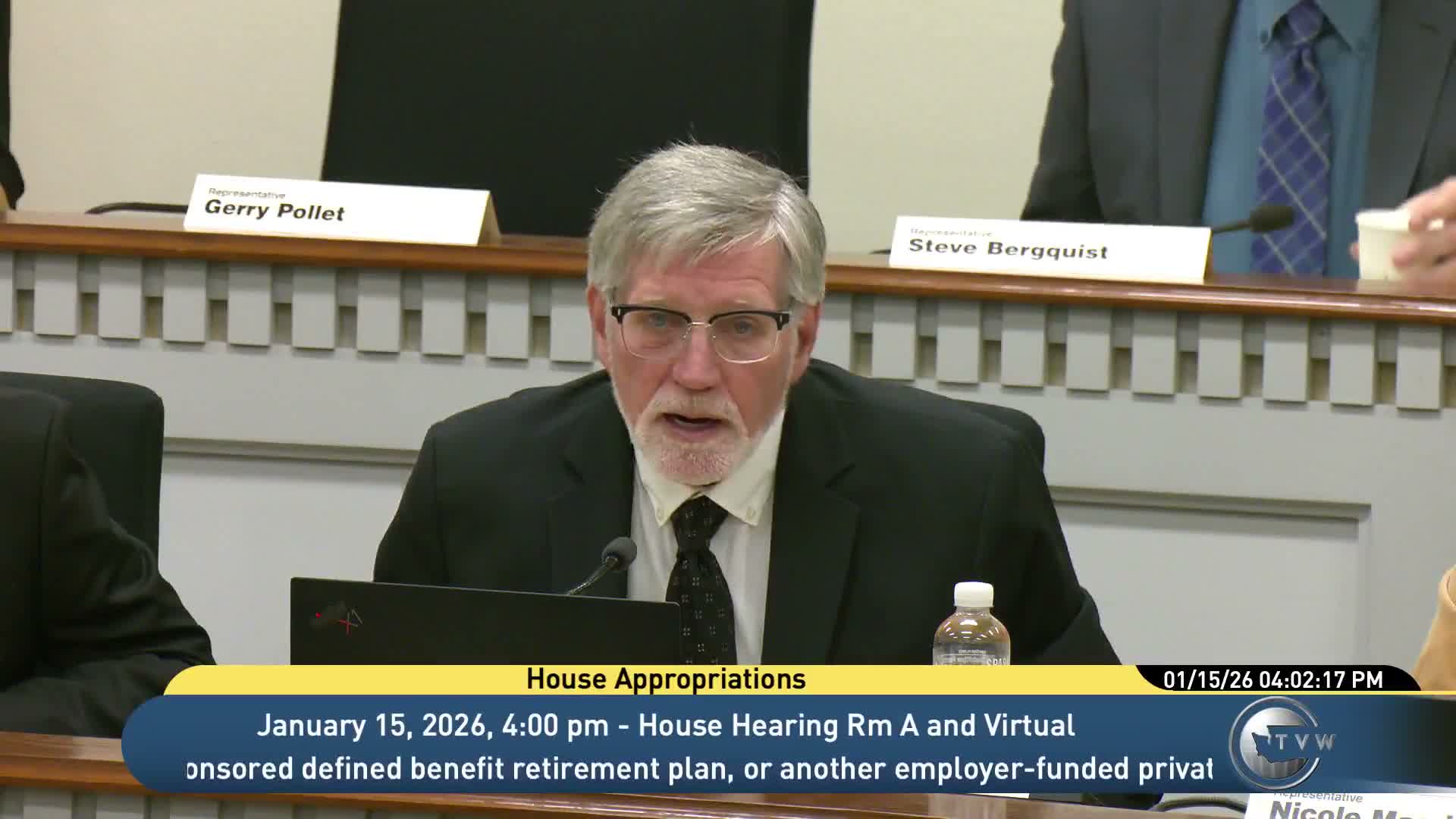
David Pringle, staff to the House Appropriations Committee, briefed two agency‑request bills from the Department of Retirement Systems aimed at simplifying retirement plan rules and preserving administrative flexibility.
Pringle said House Bill 2124 would increase the statutory threshold for offering a lump‑sum alternative to a monthly pension by raising the minimum from $50 to $250 per month, with future adjustments made by the department director to reflect inflation. "The lump sum alternative payment provisions ... are increased, from a minimum of $50 up to $250," Pringle said, and the state actuary "indicates there'd be no impact on the pension funds." He also told members the systems expect roughly $11,000 in one‑time administrative costs to update data systems.
Seth Miller of the Department of Retirement Systems said HB 2124 primarily seeks consistency across plans: "we're really moving the lump sum law to match plan 2 to match what is already in plan 3," he told the committee, and framed the measure as an effort to reduce complexity across retirement plans.
On House Bill 2125, Pringle said the bill removes a restriction enacted during the 2025–27 biennium so that certain administrative expenses used to protect pension funds (for example, legal and medical costs and statutory compliance activities) may continue to be supported from interest earnings on the pension funds. The retirement systems' fiscal note described no material actuarial effect but warned that if those costs were shifted to other sources it could increase the administrative fee employers pay.
No formal action or votes were taken at the hearing. Agency witnesses offered to provide additional information on technical implementation if committee members had questions.
The committee moved on to other agenda items after agency testimony; any amendment requests or committee fiscal analyses would be provided in later bill‑reporting documents.