Get Full Government Meeting Transcripts, Videos, & Alerts Forever!
Get email alerts on the Impaired Driving topic
No spam. Unsubscribe anytime.
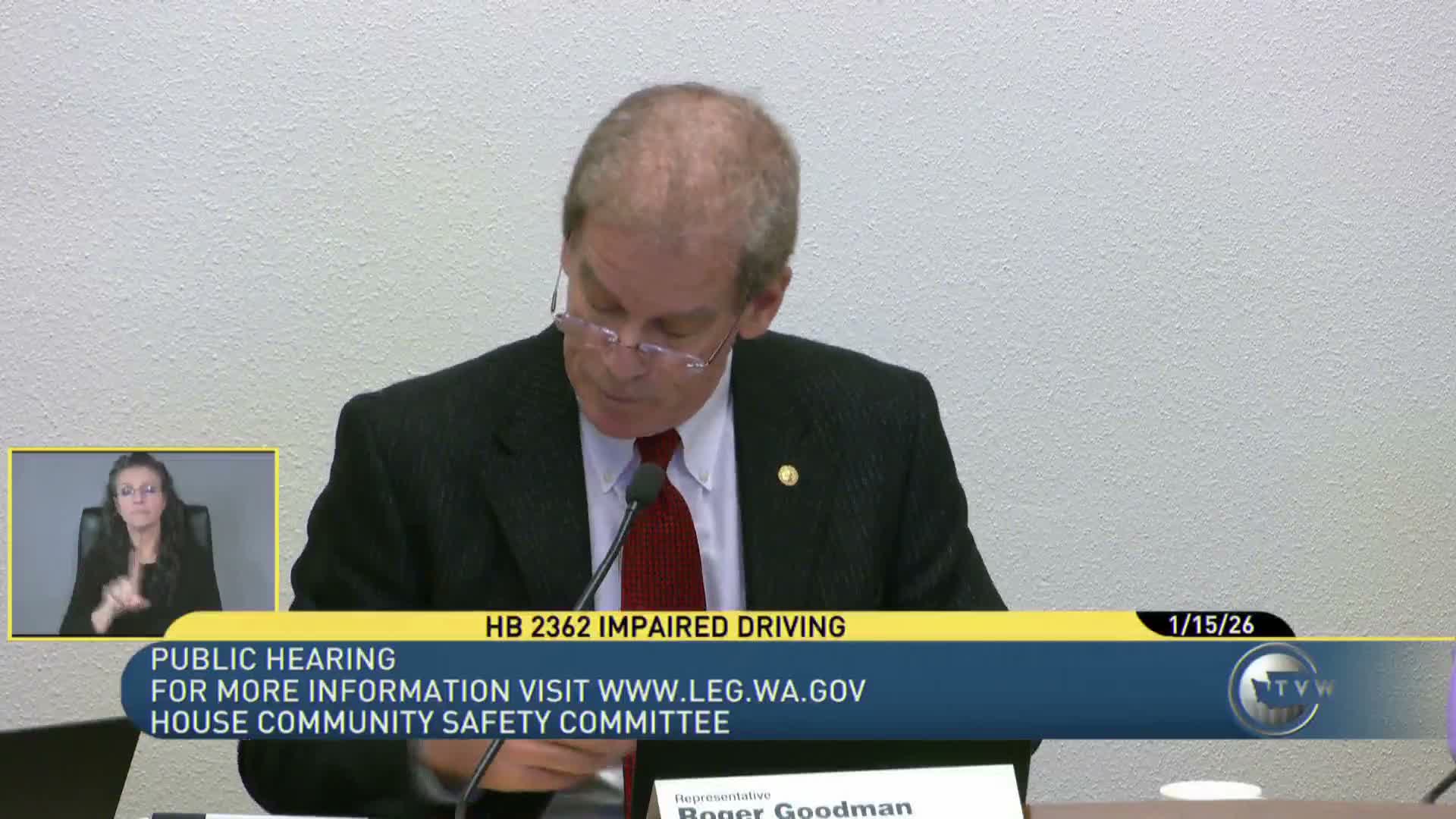
House committee hears testimony for and against lowering per‑se BAC to 0.05 in HB 2362
Summary
Representative Brandy Donaghy sponsored HB 2362 to lower Washington’s per‑se blood‑alcohol threshold from 0.08 to 0.05, require a statewide public education campaign, and direct an evaluation to the State Institute for Public Policy by March 1, 2028. Prosecutors, public‑health officials and the governor’s office backed the bill; hospitality trade groups and the criminal defense bar opposed it, citing mixed evidence and operational concerns.
House Bill 2362 would lower the state’s per‑se blood or breath alcohol concentration for impaired‑driving offenses from 0.08 to 0.05, require a statewide multilingual public information campaign administered by the Washington Traffic Safety Commission, and direct the Washington State Institute for Public Policy to evaluate impacts by March 1, 2028. Martha Whaling, committee staff, told members the bill’s overall effective date in the draft is July 1, 2026.
Representative Brandy Donaghy, prime sponsor, described the measure as an evidence‑based public‑safety proposal aimed at preventing crashes and saving lives. "We know that when we have a few drinks, we probably feel like we're fine. Data shows us that we're not," Donaghy said.
Supporters included the Washington State Patrol, prosecutors, the governor's public‑safety adviser, AAA Washington, the Washington Traffic Safety Commission, and the Department of Health. Amy Friedheim, chair of King County’s felony traffic unit, said lowering the per‑se threshold educates drivers and deters impaired driving; she cited research correlating BAC with crash risk and argued the change will reduce fatalities and save state costs tied to crashes.
Opponents from the hospitality and alcohol industries (Washington Hospitality Association, Washington Brewers Guild, Washington Wine Institute) warned the bill would criminalize responsible consumers, risk economic harm to small businesses, and pointed to Utah’s mixed early outcomes after adopting a 0.05 law. The Washington Association of Criminal Defense Lawyers and the Washington Defender Association urged a two‑tier approach, arguing that convictions should still require proof of impairment rather than relying solely on a per‑se threshold.
Victims and families gave emotional testimony urging passage. Ashley Bonas recounted the 2012 death of her sister and said, "We have known for decades that 0.08 is too late. Lowering the per se limit to 0.05 is not extreme. It is proven, and it will save lives." Prosecutors and traffic safety experts countered some industry claims about Utah, and the Traffic Safety Commission presented survey data indicating public readiness and international precedent for 0.05.
Experts also flagged operational concerns: toxicology laboratory backlogs and court resources were discussed at length. Several prosecutors and the association of prosecuting attorneys said a lower per‑se threshold could reduce caseloads over time by changing social behavior; others said lab and court capacity must be addressed in parallel. The committee closed the public hearing without a vote; members said they will consider testimony, fiscal and operational issues, and continue work next week.
No committee action was taken on HB 2362 during the session; additional briefings and possible amendments were foreshadowed.