Get Full Government Meeting Transcripts, Videos, & Alerts Forever!
Get email alerts on the Urban Growth Area Planning topic
No spam. Unsubscribe anytime.
Committee Hears Bill to Align County Regulations with City Plans Inside Urban Growth Areas; Cities and Counties Offer Mixed Views
Summary
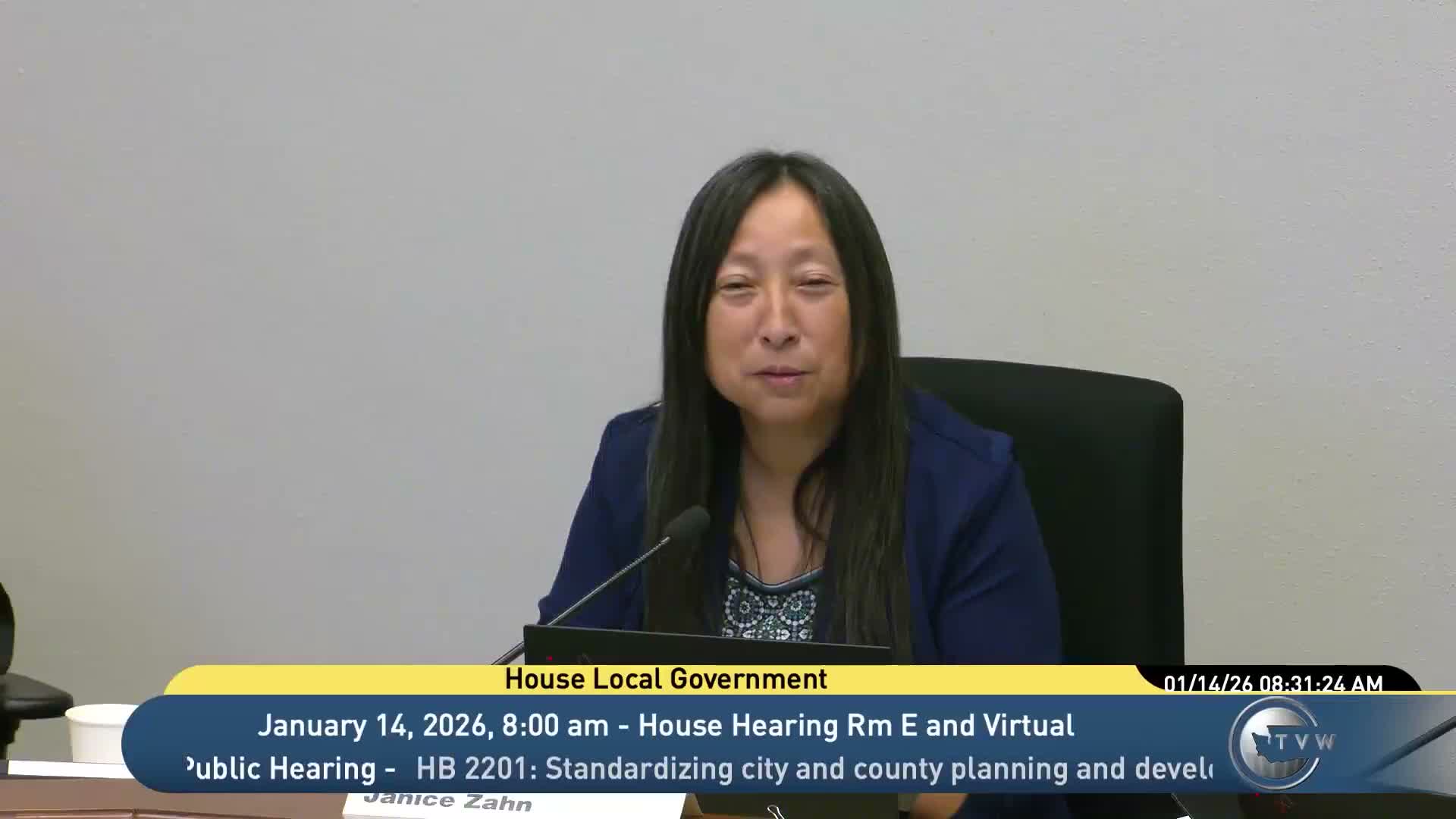
House Bill 2,201 would require county regulations within an urban growth area to conform to the city's plan/regulations at the county's next plan update unless the city agrees otherwise; city officials praised potential to reduce divergent development tracks while counties urged more work on annexation, funding and implementation.
Kellen Wright, staff to the committee, summarized House Bill 2,201 as legislation that would require counties, at the time of their next comprehensive-plan update or next implementation progress report, to ensure county plans and regulations applicable within an urban growth area conform to the comprehensive plan and regulations of the city located in that UGA, unless the city agrees to a variance or another law requires different regulations.
The bill's sponsor described the proposal as a response to inconsistent county and city approaches that can leave infrastructure misaligned and hinder planned annexations. The sponsor said the bill grew from local work on growth boundaries and noted it would benefit from more detailed work on annexations and implementation mechanics.
Dave Anderson, Senior Managing Director for Growth Management Services at the Department of Commerce, presented the Washington Zoning Atlas earlier in the meeting and told members the atlas is a statewide map of zoning information compiled by reading local zoning codes and classifying zones into consistent categories for public use and analysis. "This is basically a statewide zoning map that our team put together," Anderson said, noting the atlas lets users query attributes and link back to local development codes but is not a substitute for parcel-level verification or site-specific buildability analysis.
City officials and planners testified in favor of HB 2,201's intent. Brian Enslow (City of Vancouver) said divergence in standards across a large UGA can create long-term financial liabilities and complicate annexation, while Carl Schroeder (Association of Washington Cities) and other city representatives said greater consistency encourages annexation and long-range infrastructure planning. ‘‘The more we can get consistency, the better,’’ Schroeder told the committee.
County representatives raised implementation concerns. Kelsey Hulsey (Washington State Association of Counties) said the bill as drafted does not address existing interlocal agreements and would add complexity (SEPA thresholds, stormwater, transportation) and workload for county planning offices without dedicated funding, and urged the committee to examine annexation commitments from cities.
Several planners and local governments offered targeted suggestions — for example, drawing on Portland/Multnomah County interlocal arrangements — and emphasized the need for predictable annexation timelines and funding to make the alignment viable. There were no formal votes during the hearing; the committee closed public testimony on HB 2,201 and signaled additional work would be required to reconcile annexation and implementation issues before advancing the proposal.