Get Full Government Meeting Transcripts, Videos, & Alerts Forever!
Get email alerts on the Transportation Safety topic
No spam. Unsubscribe anytime.
Committee hears testimony on House Bill 2095 to shift civil burden in crashes that injure vulnerable road users
Summary
Lawmakers, testifiers and stakeholders debated HB 2095, which would require training for law enforcement and create a rebuttable presumption of negligence when a vulnerable user is harmed in a protected area; supporters said it would aid victims and deter dangerous driving, while insurers and municipal groups warned of litigation and insurance‑pricing risks.
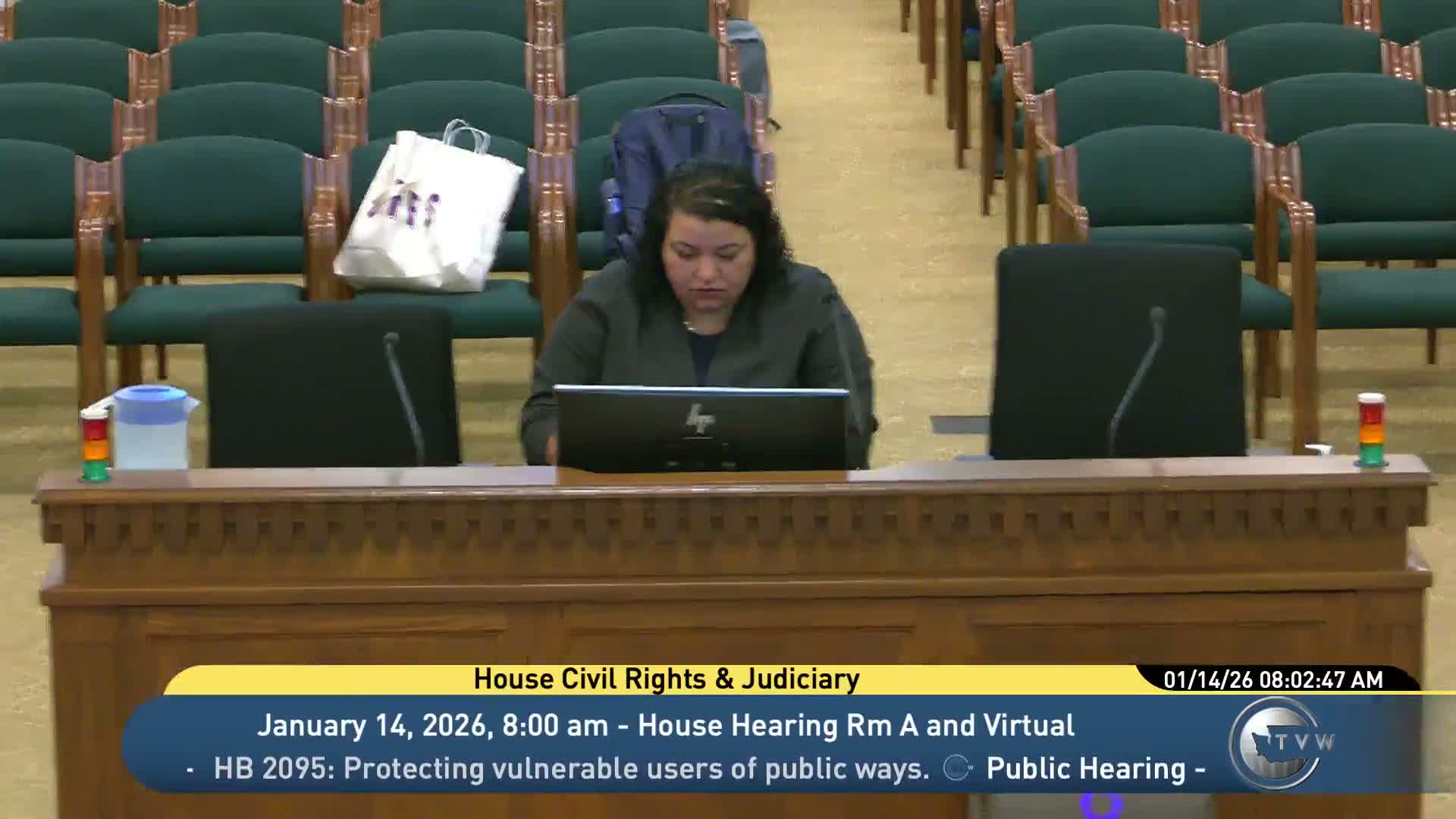
Representative Reid, the prime sponsor of House Bill 2,095, told the Civil Rights and Judiciary Committee on Jan. 14 that the measure aims to protect pedestrians, cyclists and other ‘‘vulnerable users’’ by combining mandatory training for certain officers, prosecutors and judges with a rebuttable presumption of negligence for collisions that injure or kill such users in designated protected areas.
The bill would direct the Criminal Justice Training Commission and the Administrative Office of the Courts to develop materials and classes for covered law enforcement officers, prosecutors and judges; those covered would receive training within three months of starting employment and again every three years, and must complete the courses within six months of hire and every three years thereafter. The measure also would allow prevailing plaintiffs to recover actual damages, statutory damages of $1,500, reasonable attorney fees and, under a narrow standard, punitive damages if a defendant has previously been found to have injured or killed three or more vulnerable road users.
Reid framed the provisions as complementary: better scene reporting and informed prosecutors and judges are necessary to make a presumption of liability operational. "If you're a mom walking on a sidewalk or a cyclist riding in a bike lane ... it shouldn't be your responsibility from your bedside in intensive care or your family's responsibility from your graveside to prove that you were not the one who behaved negligently," Representative Reid said.
Supporters told personal and professional stories to illustrate the bill's goals. Rita Holzman of Seattle, whose husband was killed while bicycling, urged the committee to pass HB 2,095, saying the civil system left her family with medical bills and legal fees while the driver faced minimal punishment. Vicki Clark, deputy director of Washington Bikes, said the bill corrects a systemic tilt that often gives drivers the benefit of the doubt over more vulnerable road users.
Proponents argued the rebuttable presumption would not create strict liability because defendants could present evidence to overturn the presumption; trial attorneys supporting the bill said fee‑shifting provisions aim to deter baseless defenses and reduce the cost and delay for injured parties who must currently pay experts to establish liability.
Opponents, including representatives of the Washington Defense Trial Lawyers, the Washington Trucking Associations and the Washington Liability Reform Coalition, said the combination of punitive damages and one‑sided fee shifting could create an uninsurable risk and incentivize more litigation. Michael Rhodes, past president of the Washington Defense Trial Lawyers, warned the statute could pull in corporate defendants and local governments, producing ‘‘catastrophic’’ attorney‑fee exposure that insurers cannot price easily.
Municipal representatives asked for narrow exemptions to prevent cities and counties from becoming routine defendants in cases tied to sidewalks, crosswalks or bike lanes; association representatives also requested that any training count for continuing legal education for municipal prosecutors and judges. Several witnesses suggested clarifying whether ‘‘defendant’’ in punitive‑damages language applies to individuals only or to corporate and governmental defendants as well.
Medical testimony from Ann Marie Dooley of Washington Physicians for Social Responsibility described trauma‑center cases and urged accountability as a system‑change tool, while advocates pointed to international precedent for presumptions that prioritize vulnerable users' safety.
Committee members pressed staff and the sponsor on specifics: what prior findings count toward the punitive‑damages threshold (staff said prior civil or criminal judicial findings would count), how the presumption applies when a person walks into traffic versus using a protected facility (the sponsor said the presumption applies only in statutorily designated protected areas), and how the training and liability pieces satisfy the single‑subject requirement for legislation (the sponsor said they are functionally linked).
The committee did not take a vote. The chair closed the hearing, reminded members that amendment requests are due by noon two days before a bill’s scheduled executive session and must be posted to the EBB by 4 p.m. the day before, and adjourned.