Get Full Government Meeting Transcripts, Videos, & Alerts Forever!
Get email alerts on the Food Security topic
No spam. Unsubscribe anytime.
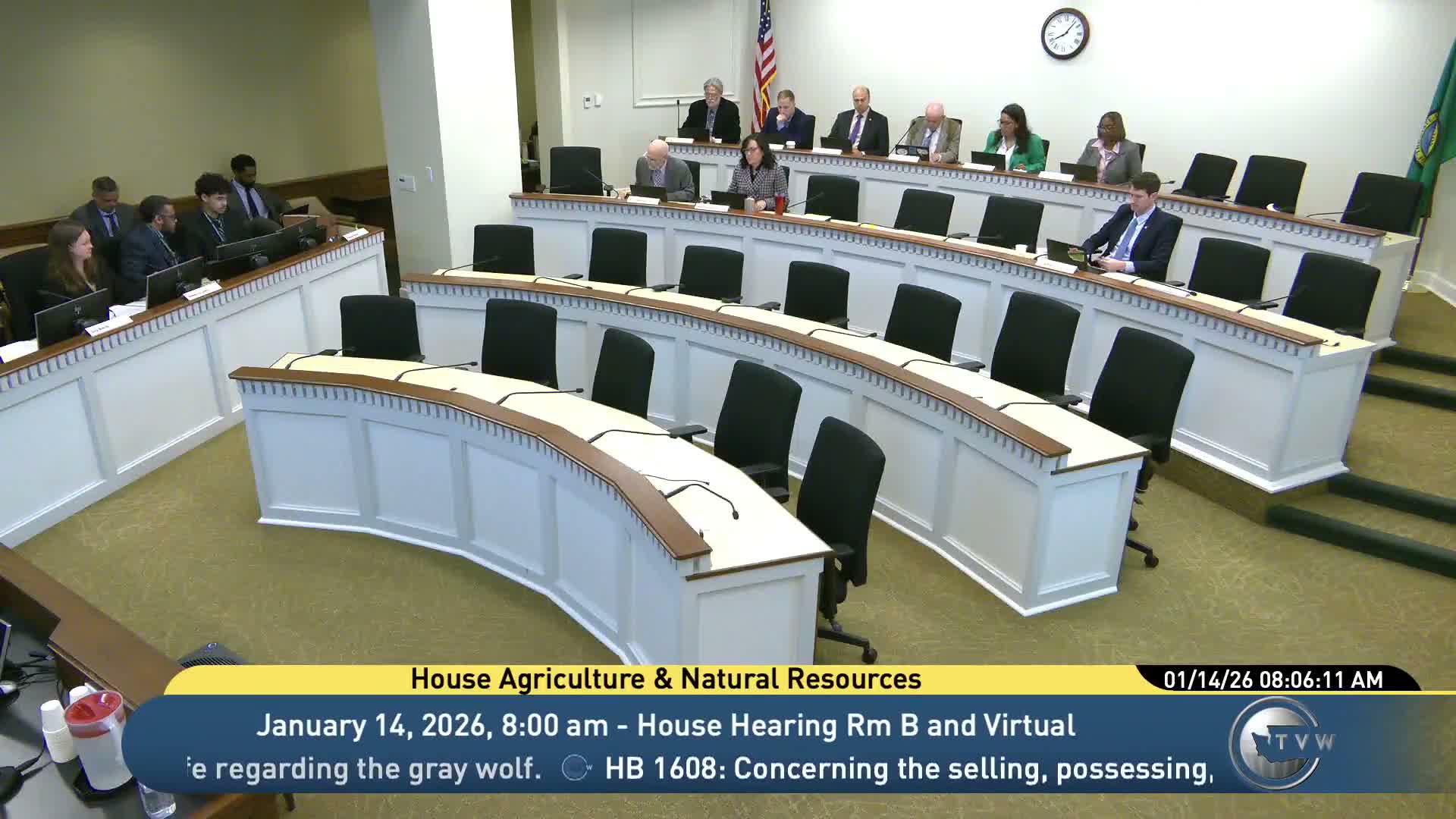
House Ag Committee Hears Broad Support for Bill to Create Statewide Food‑security Strategy
Summary
The House Agriculture and Natural Resources Committee heard hours of testimony supporting House Bill 2,238, which would direct the Department of Agriculture to coordinate a statewide food security strategy and submit it to the Legislature by Dec. 1, 2027; witnesses urged lived‑experience representation and interagency coordination.
The House Agriculture and Natural Resources Committee opened public testimony on House Bill 2,238, a proposal to charge the Washington State Department of Agriculture (WSDA) with coordinating food‑security efforts and developing a statewide food security strategy by Dec. 1, 2027.
Rebecca Lewis, research analyst and staff to the committee, summarized the bill and told members it “adds food security coordination and food system performance monitoring to the current powers and duties of the director of the Department of Agriculture” and requires WSDA to convene state agencies, nonprofit hunger‑relief organizations and federally recognized tribes while developing the strategy. Lewis said a fiscal note has been requested but had not been received at the time of the hearing.
Sponsor Representative Christine Reeves (30th Legislative District) told the committee the bill is intended to codify and coordinate work WSDA and partners did during COVID rather than to create an entirely new bureaucracy. “As somebody who grew up food insecure… I was homeless in my teens, and unfortunately, have had the experience of having to eat out of garbage cans to get by,” Reeves said, framing the bill as a response to both household‑level need and system‑level gaps.
Witnesses from hunger‑relief, producer and retail groups testified in favor. Michael Moran, longtime lobbyist for Second Harvest, described how food distribution has shifted toward more perishable, higher‑quality items and cited rising fuel and labor costs as pressures on delivery networks. “Food pantries now represent kitchens and restaurants… The second big factor that we should address is what has happened between COVID and also fuel costs,” Moran said.
Anna Nepomisseno, director of public policy at Northwest Harvest, urged inclusion of people with lived experience and small farmers on any advisory committee and noted, “Nearly 1 in 10 Washington households experience food insecurity driven largely by rising food and living costs.” Mark Strule, representing wheat, potato and cattle organizations, and Colleen Donovan of the Washington State Farmers Market Association also voiced support, pointing to partnerships that link producers to hunger‑relief programs. Donovan cited recent market data and said market programs helped redeem nearly $5,000,000 in benefits at markets in 2024.
Local officials and food‑system partners described practical gaps the bill aims to address. Brian Yambi (Pierce County Council, District 5) said federal changes and grocery closures have left some communities exposed; he noted local ARPA investments that will expire and urged state coordination to reduce duplication. Small producers and distributors—including Jillian Moore and Jeremy Vrablick—testified that integrating farm producers into hunger‑relief distribution strengthens local resilience.
Committee members asked questions about scope and cost. Representative McClintock asked how many people the bill would affect; Reeves answered with illustrative counts for various program areas (citing losses of roughly 3,700 farms in five years, about 1.1 million schoolchildren receiving school meals, and roughly 940,000 residents who use subsidy programs) and reiterated the bill primarily would codify coordination rather than create a new department.
The public hearing closed after the committee read into the record that 137 written testimonies were pro, 166 were con, and 0 were listed as other. Staff will continue committee work on the proposal; a fiscal note was pending at the end of the hearing.
Next steps: the committee moved to an executive session that same day to consider multiple bills; House Bill 2,238 received public comment but was not voted on during the public session.