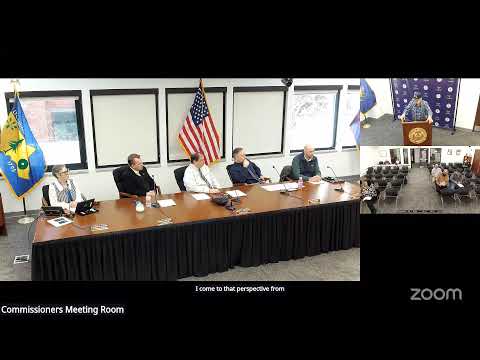
Lycoming County approves management agreement with Clinton County to address landfill debt and capacity
Loading...
Summary
Lycoming County commissioners voted to approve a two‑year agreement with the Clinton County Solid Waste Authority to manage the county’s RMS landfill, a move officials said is intended to stabilize operations as the facility carries roughly $27 million in debt and has about eight years of capacity without expansion.
Lycoming County commissioners voted to approve an agreement with the Clinton County Solid Waste Authority to manage operations at the county’s RMS landfill, commissioners said, aiming to stabilize finances and pursue expansion that officials say is necessary to maintain local waste services.
The motion, introduced as action item 7.7, passed after staff described the plan to bring in an outside management team to help run the facility. Jay Alexander, a representative of the Clinton County Solid Waste Authority, told commissioners his team will prioritize “safety, compliance, and profitability” and said his son, Cody, will serve as an on‑site point of contact. “We’re gonna get started on that on Monday,” Alexander said.
An unidentified commissioner who spoke during debate described an extensive review of landfill accounts and said the facility “sits currently with $27,000,000 worth of debt,” adding that the board and county finance staff had separated accounts to get a clearer picture of day‑to‑day operations. That same speaker said the county and its new partners expect the initial two‑year term to get the operation to break‑even if not profitable, and that the partnership could continue if needed.
Former county planning director Jerry Walls, who spoke in support, offered historical context on the landfill’s development and endorsed the decision to bring in external management. “They’ve got credible history and reputation and capability,” Walls said, referring to the incoming management team.
Clinton County representatives said the Lycoming site has limited remaining capacity without permitting and expansion work. Alexander and others told the commissioners the landfill has roughly eight years of capacity at current rates and that obtaining permitting for a new cell would likely take about five years, with an additional year or two for liner construction before new disposal could begin. “So you talk 6, 7 years until you’re ready to start dumping in a new field,” one representative said, noting the timing made expedited planning urgent.
Commissioners said they chose the management agreement to protect local jobs, preserve regional waste capacity and give county staff guidance after a difficult year of operations and turnover. The board recorded an affirmative vote to approve the agreement; the motion carried by voice vote with commissioners saying “aye.”
Next steps listed by speakers include immediate on‑site coordination between county staff and the Clinton County team, development of an annual budget and an expedited process to pursue permitting and expansion. The agreement passed does not itself authorize sale of the landfill; commissioners said sale is not currently planned and would be considered only if future reviews concluded that county ownership is not feasible.
The county did not provide a detailed timetable or budget for expansion costs during the meeting; permitting timelines and financing for any expansion were described as subject to further study and future approvals.