Get Full Government Meeting Transcripts, Videos, & Alerts Forever!
Get email alerts on the City Center Revitalization topic
No spam. Unsubscribe anytime.
Newport advances City Center policy amendments, schedules Aug. 18 public hearing
Summary
City staff and consultants presented a City Center Revitalization Plan and proposed comprehensive plan policy amendments, highlighted transportation and housing goals, and confirmed a public hearing for Aug. 18; councilors pressed staff on tree protections, public restrooms and implementation timelines.
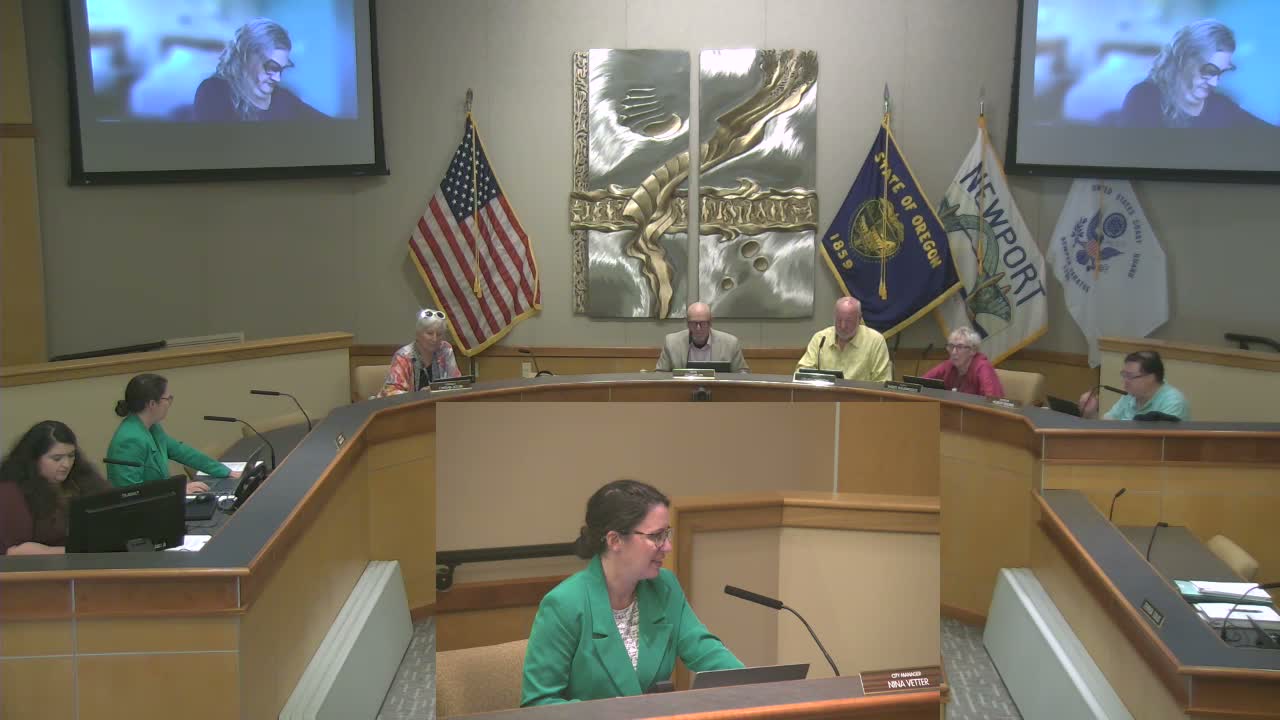
Derek Tokos, Community Development, told the Newport City Council at a work session that the City Center Revitalization Plan package—including comprehensive plan policy amendments—will go to a public hearing on Aug. 18.
The amendments update the Newport Peninsula Urban Design Plan, redefine the City Center boundary, and set policy direction on housing, streetscape improvements, transportation and incentives to spur reinvestment. Tokos said the Northside Urban Renewal District, created in 2015, carries a $40,000,000 maximum indebtedness; about $35,000,000 of that capacity remains and roughly $5,000,000 has been expended or programmed for land acquisition and transportation projects.
Why it matters: adopting the policy amendments would provide local direction that staff and consultants can use to pursue design work and to be more competitive for state and federal grants. Tokos said the amendments are policy guidance, not final project approvals, and will be followed by a separate form‑based code that sets detailed development standards for the area.
The presentation laid out the plan's three subareas—highway, core 101 and a hospital‑oriented node—and emphasized goals such as creating a walkable mix of uses, safer traffic flow, managed parking and incentives to encourage mixed‑use housing. On transportation, staff described a one‑way couplet on US 101 as the most effective solution identified by the consultants but stressed the policy does not fix a final design or construction timetable. Tokos said, “We can pick up a refinement planning effort to go a different course at any time,” and estimated major transportation changes could take about seven to 10 years to realize.
Council members pressed staff on implementation and details. One councilor asked whether adopting the policy would leave the city “handcuffed” if partner agencies such as ODOT change priorities; Tokos replied policies allow the city to pursue alternative refinement plans later and that adopting local guidance strengthens grant competitiveness. Councilor Cynthia asked about stronger tree protections and public restrooms, saying she would prefer language that would “maybe it must be preserved and replanted to create a healthy tree canopy,” and asked about dark‑sky street lighting. Tokos cautioned that replacing policy 'should' language with 'shall' or 'must' can create legal implementation obligations without an implementing program, and noted current tree protections are mostly limited to right‑of‑way rules; he said beautification and short‑term activation could include new greenery and that bus‑stop redevelopment concepts in the package may include restroom components.
Staff described outreach and participation: an advisory committee of roughly 18 stakeholders met seven times, two public engagement windows (including bilingual events and online surveys) informed recommendations, and consultant memos summarize the feedback. Tokos said the city met legal notice requirements and initially emailed about 56 people who asked to stay informed; after follow‑up the list grew to nearly 100 contacts. He said the public hearing is finalized for Aug. 18.
The package includes nine consultant memos (two are directly referenced for adoption into the comprehensive plan) and a refinement memo to the 2022 Transportation System Plan. Tokos noted prior work—such as a BLM traffic study and a Federal Lands Access Program grant for a multiuse pathway—helped secure federal funds and that locally adopted plans improve competitiveness for future grants.
What happens next: the council is scheduled to take public testimony and consider the comprehensive plan policy amendments at the Aug. 18 public hearing; the form‑based code with specific development standards will return later as a separate item. The council recessed the work session for a break and announced an executive session under ORS 192.6602(f).