Flagstaff police outline staffing, technology and a roughly $30 million capital ask
Loading...
Summary
City police presented a workload study and a multi‑million dollar plan that would add officers and investigators, modernize records/technology and rehabilitate evidence storage; staff estimated ~$30 million in prioritized capital needs and millions more in startup and ongoing operating costs.
Flagstaff City police officials on Jan. 28 presented a multi‑part plan asking the committee to consider new staffing, technology upgrades and capital improvements to bring the department closer to national workload standards.
Chief Sean Conley opened the presentation by saying the department was using a recent PFM workload assessment as a baseline for staffing and capital decisions. "We're gonna be aggressive," he said, framing the request around officer safety, training and community engagement.
Support services director Allison Hughes gave a granular look at records and evidence operations. "Right now our staffing is 2 customer service reps, 4 records technicians, 2 lead technicians, and 1 supervisor," she said. Hughes told the committee the unit handled more than 10,000 report requests in 2025, processed about 288 body‑camera video requests requiring roughly 500 staff hours of review and redaction, and has an average body‑camera turnaround of about four to six weeks. She said many workflows remain manual and are tracked in spreadsheets.
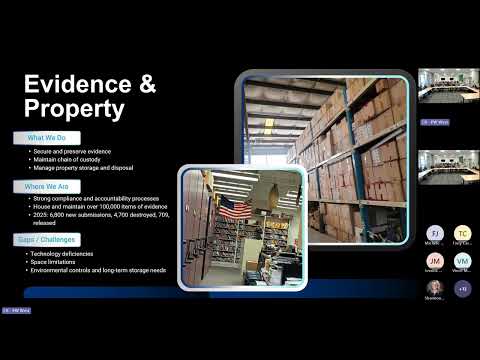
Hughes described evidence storage as a pressing capital problem: inventory tops 100,000 items across two locations, intake exceeded about 6,800 items in 2025, and staff routinely maintain paper vouchers because the current records management system lost reliable purge/reporting capability. "We keep a physical copy of every voucher for every item," she said, urging investment in a system and storage that would reduce manual rework.
On staffing, the PFM study informed recommendations across patrol and investigations. Colin Sy, representing patrol, said officers currently have roughly 10–11% of available time on shift and that the consultant recommended adding eight patrol officers and two supervisors (with other vacancies and academy candidates still pending). "PFM is recommending that we add 8 officers to the patrol division, 2 supervisors," Sy said, and presented an estimated one‑time startup of about $1.6 million for vehicles and equipment plus an ongoing added cost of about $1.8 million. Combined startup and first‑year costs for the patrol additions were presented at about $3.4 million.
Deputy Chief Charles Hernandez said PFM recommended adding 12 sworn investigators and one professional support position for investigations, which would reduce detective caseloads from roughly 250–300 per investigator to about 120–150 and allow more victim‑centered, proactive work. "That represents roughly a 40 to 50 decrease in the workload that they're carrying," Hernandez said, arguing the change would improve follow‑up, clearance rates and prosecution outcomes.
Chief Conley laid out three capital priorities: a North expansion with training spaces, vehicle storage and wellness/administrative space; a renovation of the current headquarters to free administrative space; and a rehab of the off‑site evidence warehouse that includes a proposed ~1,500‑square‑foot public access area for property retrieval. The North expansion and renovation were estimated at just under $25 million; evidence warehouse rehab was estimated at about $3.8 million, yielding a combined capital estimate staff characterized as approximately $30,000,652 for the identified public safety priorities.
Technology investments were also highlighted. Staff described a Peregrine/CAD pilot and potential integration with a regional operations center that would consolidate real‑time data and video across agencies. Initial set‑up for the ops‑center concept was estimated at about $1.6 million; a nearer‑term technology package to maintain modern capabilities was listed at roughly $599,000, and staff presented an overall near‑term technology/personnel/contract/commodity ask of about $3.1 million.
Committee members questioned the division between one‑time startup costs and ongoing operating expenses, procurement strategies, payroll fragility and where detailed requests appear in the budget process. Allison Hughes said personnel costs make up roughly $20 million of the department's operating budget and total operating costs run about $22.6 million; grants were listed at about $3.9 million in the current year. Staff described how budget team reviews produce a high‑level recommended budget for council while detailed line‑item spreadsheets are maintained internally for prioritization.
Public‑facing concerns also surfaced: Dorothy Gieschi noted past evidence handling in a high‑profile case, saying "I think the department did a huge disservice to the Sarah Siganitzo case," prompting discussion of changes in state law that now limit destruction of homicide and certain violent‑crime evidence.
The committee set a scheduling decision earlier in the meeting to meet next on Wednesday, Feb. 18. Staff said more detailed documents, including the full PFM report and granular budget spreadsheets, will be provided to the committee and to council as the budget process continues.
What's next: staff will make the PFM baseline and detailed cost breakdowns available to the committee and work with the budget team and council on prioritization and procurement strategy. The committee will reconvene Feb. 18 for further deliberations.