
Residents urge Manatee commissioners to block rezoning that could enable Terracea cruise port
Get AI-powered insights, summaries, and transcripts
Subscribe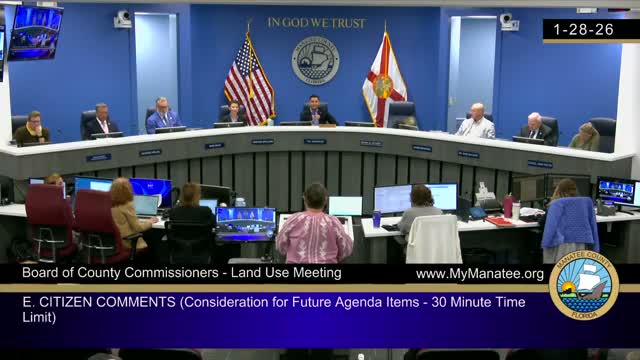
Summary
Dozens of Terracea Island residents told the Board of County Commissioners that rezoning coastal parcels to industrial or heavy‑use could allow a cruise terminal that would require dredging and increase traffic, pollution and noise in the Terracea Aquatic Preserve.
Dozens of residents from Terracea Island and nearby communities urged the Manatee County Board of County Commissioners on Jan. 28 to oppose any rezoning or comprehensive‑plan amendments that could enable a cruise ship terminal near the Terracea Aquatic Preserve.
Speakers said the land is now zoned low‑intensity residential (Res‑1) and protected by the county’s comprehensive plan, and that industrial zoning would be inconsistent with nearby conservation areas and longstanding local expectations. "Industrial zoning is intended for heavy infrastructure, freight movement and continuous operations — those uses are not compatible with residential communities like Palmetto Point nor with an aquatic preserve," said Elaine Johnson, a Terracea resident.
Several residents cited potential environmental consequences—dredging, turbidity, seagrass loss and long‑term maintenance dredging—and said the economic benefits would flow to outside investors rather than local families. Elizabeth Minette, who identified the developer as SS Marine and named investors she said include Blackstone Infrastructure Partners and a foreign investor, said the proposal would “sacrifice one of the last undeveloped stretches of Tampa Bay.”
County officials responded that any formal application must follow the normal public‑hearing process. The chair said the county has no preexisting definition in the comp plan for ports outside Port Manatee and that a concept alone does not remove residents’ right to a public hearing. Commissioners urged the public to submit comments and promised the project would be considered in public as applications move forward.
The speakers urged the Board to guard the comp plan and zoning rules that protect coastal wetlands and limit heavy infrastructure near environmentally sensitive waters. Several asked the county to treat any rezoning or map amendment as a major land‑use decision that should not be advanced on the basis of a single project.
What happens next: No formal land‑use change was before the board today. Commissioners said any developer must submit a land‑use application and site plans for public review; those materials would trigger staff reports and public hearings.