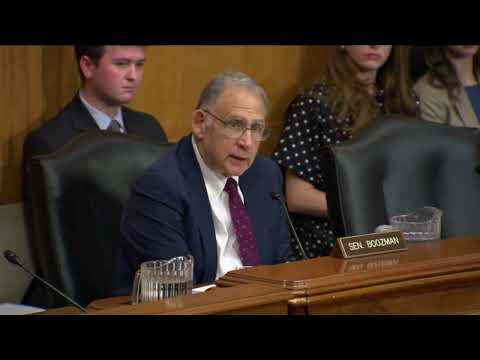
Senator presses officials on backup-generator rules and federal permitting to keep data-center investments in Arkansas
Loading...
Summary
At a federal hearing, an unnamed senator asked witnesses how EPA and federal permitting reform can allow emergency backup generators during storms and provide predictable, technology-neutral permitting to attract data centers and manufacturers to Arkansas.
An unnamed senator used a committee hearing to press energy officials and witnesses about two linked issues: whether the Environmental Protection Agency can allow more flexibility for emergency backup generators during grid crises, and how federal permitting reform can complement state actions to attract data centers and manufacturers to Arkansas.
The senator said a recent winter storm brought ice, snow and sleet to Arkansas and much of the country and praised local utilities and linemen for preparations. “Department of Energy provided proactive relief in allowing the use of backup generators,” the senator said, and noted that “EPA administrator Zeldin has also made operational flexibility a priority.” The senator asked officials for recommendations on how EPA could enable broader flexibility for backup generation in grid emergencies and how comprehensive permitting reform could help utilities better prepare for future events.
Mr. Terry, a witness who spoke in response, commended utility workers and said cooperation is key. “Cooperation between EPA, the governor’s offices, and the Department of Energy in these emergency situations” is fundamental, he said, adding that emergency measures should ensure generators come online when needed and are prepared. He characterized the immediate measures as operational coordination rather than a permanent reform and offered to provide additional details in a follow-up.
The senator also referenced recent state-level permitting changes, saying that with “chairman Westerman’s passage of the Speed Act and Governor Sanders signing energy regulatory reforms into state law, Arkansas is emerging as a national leader in common-sense permitting reform.” He asked how federal reforms could provide the additional certainty — particularly around timing and technology neutrality — that would make projects viable investments.
Mr. Terry said state actions help attract investment but that federal permitting certainty remains critical. He urged that federal reforms provide predictable timing and project neutrality so businesses are not pushed to locate overseas, calling the current opportunities “once-in-a-generation.”
Ross Hopper, another witness, said big data centers and cloud infrastructure seek “the electrons as quickly as they can,” with solar and storage often part of the solution but not the entire one. She advocated for “technology-neutral, technology-agnostic” permitting with clear timelines and predictable environmental review for all projects and warned against “weaponizing the permitting system” through shifting interagency control.
The exchange concluded without any formal votes or directives recorded in the transcript. Witnesses offered to follow up with more detailed recommendations about emergency generator operations and permitting timelines; the senator emphasized urgency to preserve investments and grid reliability.
Next steps were not specified in the transcript.