CDC official urges standards and interoperability to speed medical-legal death data for public health
Get AI-powered insights, summaries, and transcripts
SubscribeSummary
Margaret Warner of the National Center for Health Statistics told an FTCoE webinar that better data standards, APIs and interoperable systems (HL7/FHIR) can make medical-examiner and coroner data timelier and more useful for public health, safety and resource planning. She highlighted provisional overdose counts and described federal data systems that rely on MDI data.
Margaret Warner, an epidemiologist at the National Center for Health Statistics, told participants in a Forensic Technology Center of Excellence webinar that medical-examiner and coroner (MDI) data are essential for identification, public-health surveillance and prevention and for justifying office staffing and budgets.
Warner said MDI offices collect diverse materials — scene reports, witness statements, medical and prescription histories, autopsy findings and laboratory results — and that the most enduring record is the death certificate. "The most pertinent information is captured on the death certificate," she said, adding that more detailed case files or case-management systems hold material used for investigations and research.
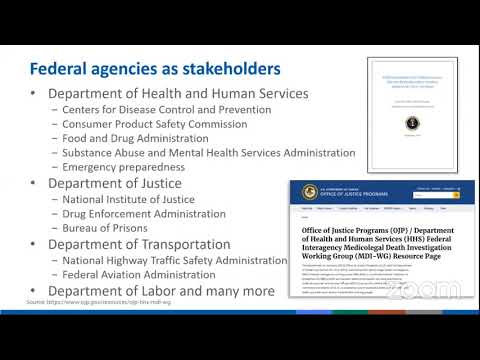
Why it matters: Public-health agencies, safety partners, law enforcement and researchers rely on MDI information to monitor causes of death, detect emerging threats and evaluate interventions. Warner cited a 2016 White House OSTP report showing that more than 40 federal agencies use MDI-derived data and described federal systems that aggregate those data, including the National Vital Statistics System (NVSS), the National Violent Death Reporting System (NVDRS) and state overdose-reporting systems.
On overdose surveillance, Warner provided provisional national figures for the 12-month period ending March 2021: "the number of reported drug overdose is about 96,779," with a projected final total closer to 99,000 once all death certificates are processed, representing roughly a 30.8 percent increase from the prior 12 months.
Modernization and standards: Warner described a multi-pronged modernization effort focused on common data elements, transport standards and secure APIs so jurisdictions can share timely, comparable data. She said the effort centers on a common core of variables (identification, demographics, cause and manner of death, time and location, medical and social history, toxicology) with cause-specific elements added where needed. She named HL7/FHIR as the likely transport model for interoperable exchanges between case-management systems and electronic death registration systems (EDRS).
"An API is an application programming interface... It's a way that APIs are used for when data systems are talking to each other," Warner said, illustrating how a case-management system could match a decedent with a funeral director's EDRS submission to reduce duplicate entry.
Tools and resources: Warner said the CDC is not building a single case-management product but is developing open-source code and a mapper to translate diverse vendor systems into a common standard. She noted the Forensic Technology Center of Excellence is conducting a landscape analysis of existing private MDI systems and that some states repurpose grant funds to upgrade local systems.
Stakeholder systems: Warner encouraged MDI professionals to report adverse events to FDA MedWatch and VAERS, to use NAMUS for unresolved identifications, and to notify CPSC's MECAP when consumer products may be implicated in a death. She also described an interagency working group convened by HHS and the Department of Justice that includes a few death investigators and invites input from professional associations including the National Association of Medical Examiners, the International Association of Coroners and Medical Examiners and ABMDI.
Audience concerns and Q&A: In response to questions, Warner acknowledged race and ethnicity fields are an area for improvement — OMB racial/ethnic classifications exist but many local systems lack self-reported detail — and she invited practitioners to engage with standards development. On funding, she said there is no dedicated national fund for case-management systems but that grants have been repurposed in some states and CDC's open-source work could lower barriers to interoperability.
The webinar closed with resource links from FTCoE and an invitation for attendees to complete a feedback survey. The interagency resource page Warner cited provides additional documentation and opportunities for community input.