
HRSA outlines FY26 National Technical Assistance Program: three national awards, $8M per award per year, four-year period
Get AI-powered insights, summaries, and transcripts
Sign Up Free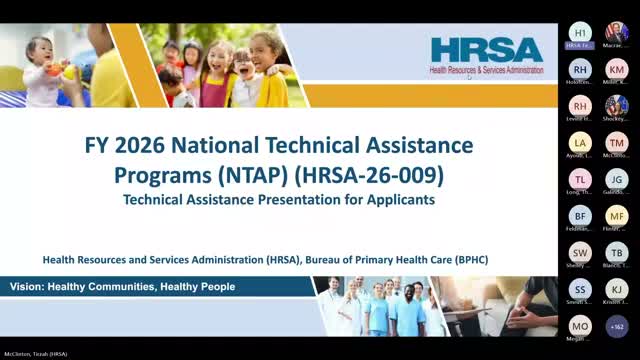
Summary
HRSA’s Bureau of Primary Health Care said the FY2026 NTAP NOFO funds three national awards of up to $8 million each per year for four years, shifts to outcome-focused cohorts, and sets application requirements and deadlines; the webinar answered applicant questions on eligibility, budgets, and staffing limits.
Kayla Miller, lead analyst for the National Technical Assistance Program team in HRSA’s Bureau of Primary Health Care, opened a webinar explaining the fiscal year 2026 NTAP notice of funding opportunity and how organizations should prepare applications.
The Health Resources and Services Administration plans to fund three national NTAP awards of $8,000,000 each per year, with a four-year period of performance running from August 1, 2026, to July 31, 2030. “We are going from where where we used to fund 22 organizations to now 3 national organizations,” said Jim McCrae, associate administrator for the Bureau of Primary Health Care, who introduced the major changes. McCrae said the program’s annualized funding is approximately $24,000,000 and that the NOFO is closely aligned with the authorizing health center statute (section 330(l)).
Why it matters: NTAP award recipients develop, deliver, coordinate and evaluate technical assistance for health centers nationwide. HRSA said the shift to larger, national awards will concentrate TA resources and requires applicants to deliver intensive, outcomes-focused support (including multiyear cohorts) that reach many health centers.
What applicants must know: HRSA will accept one application per organization; organizations may appear as subrecipients or contractors on other applicants’ proposals but may only submit one primary application. Applications are due March 31, 2026, by 11:59 p.m. Eastern time through grants.gov. The page limit for narrative attachments is 80 pages; reviewers will not read beyond that limit.
Applications must identify one of three NTAP categories — clinical and preventive excellence, operational excellence, or the national TA and coordination center — and propose plans to meet category-specific objectives. The project narrative includes seven sections (introduction, need, response, collaboration, impact, capacity and support requested). HRSA enumerated scoring weights: need (15 points), response (two sections, 15 points each), collaboration (10), impact (15), capacity (25), and support requested (5). The introduction is not scored.
Program structure and TA formats: HRSA described three TA formats. National audience TA is short and didactic (for example, webinars). Communities of practice are small-group peer-learning series that run at least six sessions per budget year. Outcomes-focused cohorts are intensive, multiyear efforts that must include at least 40 health centers and retain 90% of cohort members year-to-year; cohorts are intended to drive measurable improvements in priority areas such as hypertension and pediatric nutrition.
Budget and personnel rules: Applicants may request up to $8,000,000 per year; year‑2 through year‑4 requests may not exceed the year‑1 request. Applicants will submit the SF‑424A and a budget narrative and must include a staff justification table for direct hires and individual contractors. Kayla Miller said, “Your application will not be eligible if you request more than $8,000,000 in federal funding.”
On contractor pay limits, a grants management specialist explained the federal salary cap and hourly equivalent: the Executive Level II salary for 2026 ($228,000) divided by 2,080 hours yields a maximum of $109.62 per hour for contractors who are not considered subject‑matter experts or consultants. Subject‑matter experts and consultants may be treated differently and can be exempt from that specific hourly limit where the NOFO permits.
Allowable and ineligible costs: HRSA listed ineligible uses of NTAP funds, including costs already charged to other federal awards, construction or minor alteration, conference sponsorship, and paying for NTAP staff professional development. Outcomes-focused cohorts may include funding for up to two in-person meetings per cohort for which travel, lodging and per diem costs may be covered; communities of practice are intended as shorter-term virtual or local peer-learning activities and generally do not include participant travel reimbursement.
Data and measurement: Where objectives reference Uniform Data System (UDS) measures, applicants must use UDS data for measurement. HRSA said it will use 2025 UDS quartile data after awards are made to identify health centers at or below the third quartile to populate outcomes-focused cohorts.
Reporting and monitoring: Award recipients will participate in regular check-ins, submit an annual Federal Financial Report (FFR), an annual noncompetin continuation (NCC) progress report documenting progress on the project work plan and objective targets, and a final report at the end of the project including outcomes and lessons learned.
Questions and next steps: During a Q&A session, panelists clarified that an organization must choose one NTAP category for its primary application, explained subaward and contractor participation, and offered guidance on application formatting (attachments may be portrait or landscape but must print/read clearly when combined into a single PDF). For grants process issues, applicants were directed to grants.gov support and to use the BPHC contact form for follow-up technical assistance. Kayla Miller closed the webinar urging organizations to consider whether NTAP is the right opportunity for them and to submit remaining questions via the BPHC contact form.