
DRBC report: sea level rise could push saltwater upriver toward Philadelphia‑area intakes, model shows
Get AI-powered insights, summaries, and transcripts
Sign Up Free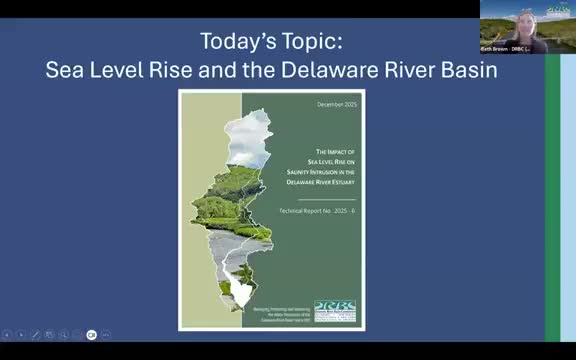
Summary
A Delaware River Basin Commission technical report and 3‑D hydrodynamic model show sea level rise and past channel dredging could move the estuary’s salt front upstream — in some scenarios approaching or exceeding locations of major drinking‑water intakes — prompting DRBC to fold the results into a Water Resources Resilience Plan and further study.
The Delaware River Basin Commission on a recent webinar unveiled a technical report and companion model that projects how sea level rise could move saltwater farther upstream in the tidal Delaware River and Delaware Bay, potentially threatening infrastructure and drinking‑water intakes that serve parts of the Philadelphia metropolitan area.
"If saltier water gets as far upstream as some of the drinking water intakes, which it hasn't done in a very long time, you can have taste and odor controls," said Amy Shall Cross, manager of water resource operations at the Delaware River Basin Commission, during the webinar presentation. Cross led the report's analysis of salinity intrusion and the commission's tests of management options.
The study used a three‑dimensional hydrodynamic model (SM3D, built with EFDC) calibrated and validated across multiple years and flow/tide conditions to simulate how salinity and circulation respond to a range of sea level rise scenarios, historical low‑flow analogs and changes to the estuary (for example, channel depth and marsh area). Model outputs include water surface elevation, currents, temperature and salinity.
Key findings presented by the commission include:
- Sea level rise is a dominant driver of upstream salt transport. The study examined scenarios spanning roughly 0.3 meters up to about 1.6 meters relative to mean sea level in 2000 and found progressively larger upstream shifts in the estuary's salt front as sea level rises.
- Under historical low‑flow analogs (the study used a surrogate of about 2,500 cubic feet per second representing the 1965 drought), the salt front could reach or exceed the Schuylkill River (river mile 92.5) even with the commission's Trenton flow objective in place; at roughly 1 meter of sea level rise the salt front could move near the Benjamin Franklin Bridge, and higher‑end scenarios could approach major drinking‑water intakes around river mile 110.
- Federal navigation channel deepening (dredging to about 40–45 feet between 2012 and 2016) increases upstream salt transport by roughly two miles in the model runs, though the commission said sea level rise has a much larger effect overall.
The report also tested model sensitivities: marsh area representation and vegetation friction, bank erosion under increased storminess, background chloride increases in the basin and different storage‑release strategies. Cross said those sensitivity tests matter because they alter how and how far the salt front migrates under particular combinations of tides, river flow and ocean conditions.
"We feel it's important to look at a range of options," Cross said, explaining why the team ran multiple sea level and management scenarios and why the model will continue to be refined as new measurements and studies become available.
Fangyu (Fang Wei) Chen, the commission's senior water resource engineer, described technical model choices: a three‑dimensional approach was necessary to capture vertical stratification, density‑driven exchange flows, and the interaction of tidal and river forcings that produce the longitudinal and vertical salinity gradients observed in the estuary.
Kristin Momen Cavanagh, the commission's executive director, said the sea‑level/salinity work will inform a newly directed Water Resources Resilience Plan. "The DRBC has intentionally been considering climate change effects on water resources for almost 2 decades now," she said, noting the commission is finalizing a phase‑1 scoping document this quarter and has begun a phase‑2 gap and vulnerability analysis to prioritize actions the commission can take within its authority.
Avery Lentini, DRBC community engagement specialist, said the commission will hold an Advisory Committee on Climate Change meeting on February 17 to dig deeper into the modeling and that staff will share a post‑webinar social media toolkit and project materials for partners seeking to disseminate findings.
The presenters emphasized that the model was developed to evaluate the effectiveness of DRBC's drought management program and the Trenton flow objective under future conditions, not as a final regulatory determination. Cross said the study incorporated external technical review (a commissioned technical review panel, independent hydrodynamic modelers and local experts) and that comments were incorporated into the final documents.
Next steps cited by DRBC include refining the model as new data arrive, integrating the modeling into the Water Resources Resilience Plan and continuing stakeholder engagement through advisory committees and public input opportunities. DRBC staff said any consideration of regulatory changes or formal guidance would follow from additional technical and policy analysis in the resilience planning process.
The commission shared report documents, a calibration appendix and registration information for upcoming advisory‑committee meetings; staff closed the webinar by pointing participants to drbc.gov for resources and listserv signups.