
NCAI, NARF webinar: Tribal citizens told how to protect themselves during ICE encounters
Get AI-powered insights, summaries, and transcripts
Sign Up Free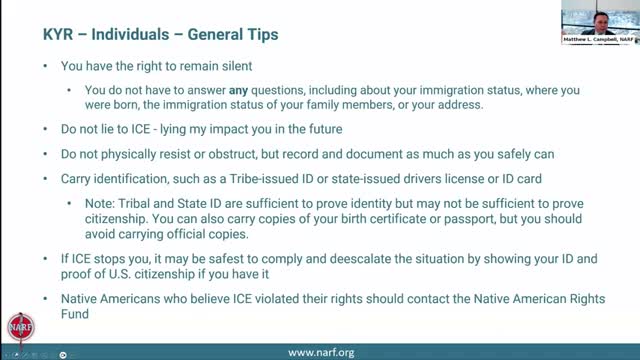
Summary
National Congress of American Indians and Native American Rights Fund lawyers advised tribal citizens that tribal IDs are valid forms of identification, recommended safety-first actions during ICE contacts, and urged documentation and legal referrals; presenters emphasized seeking tribal counsel for unique legal questions.
Larry Wright Junior, Executive Director of the National Congress of American Indians, opened a Know Your Rights webinar saying many tribal communities face “uncertainty, frustration, and outright anger” and that attendees should receive clear, practical guidance to stay safe.
Beth Wright, staff attorney at the Native American Rights Fund, led a detailed run-through of steps individuals can take if they encounter Immigration and Customs Enforcement (ICE). She stressed that people should balance asserting legal rights with personal safety: "You always have the right to remain silent," Wright said, and cautioned against lying to ICE or physically resisting officers.
Wright told listeners that tribal IDs are a valid form of federal identification in the United States, though they may not alone prove U.S. citizenship. She recommended carrying some form of identification and, where feasible, a secondary document (a state ID, passport copy, or birth certificate) to help de-escalate encounters if agents question tribal credentials.
The presentation differentiated types of interactions and the legal thresholds that apply. At a home, Wright said, do not open the door for an ICE agent unless they present a judicial warrant signed by a judge; administrative warrants signed by ICE do not authorize entry without consent. In a car stop, drivers must show a driver’s license, while passengers do not have to provide ID unless they are being detained; attendees were advised to ask officers whether they are free to leave.
Wright urged people who are detained to remain calm, assert their right to remain silent, state U.S. citizenship if applicable, request an interpreter when needed, and ask for a supervisor if a tribal ID is rejected. She also encouraged documenting encounters after release—including badge numbers, agent names, number of agents, what was said, and photographs of any property damage or injuries—and to seek medical care and legal counsel when appropriate.
The webinar included practical safety planning: memorize emergency contacts, give schools or daycares emergency authorizations, keep duplicates of vital documents in safe locations, and prepare an attorney or hotline list in advance. Wright directed attendees to NARF for follow-up help and legal referrals.
Speakers repeatedly emphasized that the session provided general information, not individualized legal advice, and encouraged people to consult an attorney or tribal legal counsel for specific circumstances. The webinar concluded with contact information for NARF and a promise that slides and the recorded video would be posted for broader access.