DARPA announces Lift Challenge to spur heavy‑lift drones, outlines Dayton event and FAA exemption pathway
Loading...
Summary
DARPA unveiled the DARPA Lift Challenge, a competition that requires an aircraft (including power source) to weigh no more than 55 pounds and lift at least 110 pounds, with teams to compete on a five‑nautical‑mile course. DARPA said it coordinated with the FAA on an exemption pathway and proposed an August event in Dayton, Ohio.
Philip Smith, program manager for the Defense Advanced Research Projects Agency (DARPA) Lift Challenge, announced a new competition aimed at breaking the ‘‘heavy‑lift’’ bottleneck in vertical flight and accelerating designs that can lift large payloads relative to their own weight.
"We stand before a new fundamental challenge," Smith said, framing the effort as an attempt to combine radical airframe, powertrain and control ideas to change what small vehicles can carry. The competition’s core metric will be payload‑to‑weight ratio: DARPA requires that the entire aircraft, including its power source, weigh no more than 55 pounds and that the system lift at least 110 pounds while completing a course.
Smith said the course will be a five‑nautical‑mile circuit intended to reward designs that balance raw power and sustained efficiency. Teams will be ranked by their payload‑to‑weight ratio on the course; DARPA will also award subjective category prizes for ‘‘most revolutionary aerodynamic,’’ ‘‘most revolutionary powertrain’’ and ‘‘most promising’’ designs.
The challenge, Smith said, is timed to take advantage of several converging technologies: advanced composites and additive manufacturing that make high strength‑to‑weight airframes broadly accessible; gains in electric motor power density and lightweight combustion options; affordable computational fluid dynamics tools; and open‑source flight controllers that permit unstable, high‑performance configurations.
Smith framed the competition with use cases for heavier small aircraft, citing humanitarian relief, battlefield resupply and urban construction lifts as examples of tasks that could be cheaper or quicker if small aircraft could reliably lift larger loads. "That is humanitarian aid at the speed of need," he said, describing a hypothetical scenario in which a 50‑pound aircraft delivers a 200‑pound resupply package to an isolated village.
Addressing regulatory hurdles, Smith identified the Federal Aviation Administration’s (FAA) Part 107 55‑pound limit as a barrier to demonstrating heavy lift. He said DARPA has worked with the FAA to create a clear exemption pathway that will allow challenge participants to fly systems above the typical Part 107 limit under an FAA process. Smith said he would submit the relevant exemption paperwork and expects the standard 120‑day timeline for approvals to be shortened through prior coordination; registered teams will receive documentation (an appendix to the exemption) to be legal to fly under the event’s conditions.
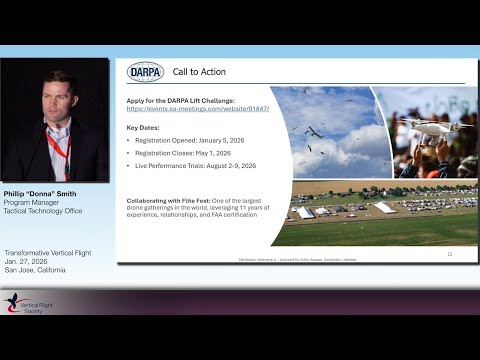
On logistics, Smith said DARPA is proposing to hold the contest in August at the National Museum of the U.S. Air Force in Dayton, Ohio, with Flight Fest programming and public activities planned around the event. He acknowledged some event details were not finalized and that FAA safety spacing (for example, separation distances and geofencing around start/landing areas) remained under discussion.
Asked how DARPA would ensure the challenge produces fieldable technology, Smith replied that success is not guaranteed and that uncertainty is part of DARPA’s mission: "You don't," he said. He called that uncertainty an acceptable program risk in pursuit of potentially transformational outcomes.
Prize details were presented as approximate. Smith said the total prize pot is on the order of $6.5 million (he provided the figure as an estimate during the session) and that teams that do not meet the 4:1 payload‑to‑weight threshold would receive a reduced share. Smaller category prizes will be awarded for the subjective categories.
Smith closed by saying the Lift Challenge aims to ‘‘unshackle’’ competitors from nonessential requirements (autonomy or sensor suites) so teams can focus directly on fundamental lift performance. The program begins with public outreach and technical requests for information; DARPA directed interested teams to the Lift Challenge web page and its agency homepage for registration and details. The session ended with a short Q&A and a break for lunch.