
Meridian staff recommend direct ‘D’ alignment in Stratford‑to‑Eagle feasibility study; council stresses preserving alternatives
Get AI-powered insights, summaries, and transcripts
Subscribe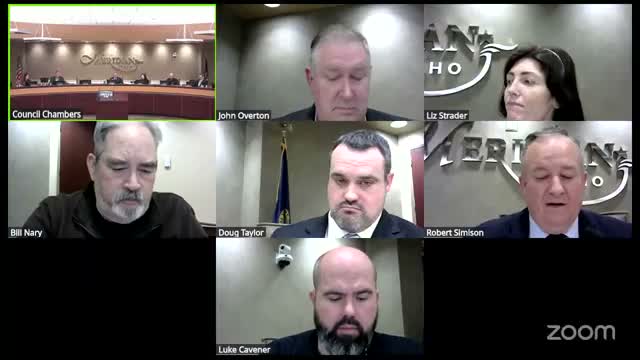
Summary
City staff presented a Stratford‑to‑Eagle transportation feasibility study and recommended a straight 'D' connector as the top option for improving local connectivity and encouraging redevelopment; councilmembers urged preserving other alignments and updating the Ada County Highway District (ACHD) master street map before development proceeds.
City staff recommended prioritizing a straight extension of Central Drive — labeled Concept D in the study — as the preferred transportation connection between Central Drive and Eagle Road, arguing it best meets goals for improved connectivity, emergency access and economic redevelopment.
Carl Anderson, long‑range associate planner for the City of Meridian, introduced the final technical memorandum for the Stratford-to‑Eagle study and said the work builds on the 2019 Meridian area plan. Consultant Nick Foster of Kittelson and Associates told the council the study screened five alignment concepts and found the best overall performance for the city's objectives in Concepts D and E, with D as the top performer. "The goal here was to look at how can we improve connectivity in this area of Meridian," Foster said, noting the study also considered opportunities to extend utilities to areas served by aging wells and septic systems.
Consultants described tradeoffs among the three preferred concepts (C, D and E): Concept C uses mostly existing roads and requires less new right‑of‑way but offers less redevelopment uplift; Concept D is the most direct alignment and would support larger‑scale redevelopment if parcels are assembled; Concept E provides freeway visibility attractive to market‑driven commercial uses but faces tighter physical constraints. Brooke Green, who worked with the team, said ACHD informed staff that some intersections in Concept B would not meet ACHD spacing standards and that right‑of‑way and existing buildings would constrain an interstate‑adjacent alignment.
Councilmembers repeatedly returned to corridor preservation. "I think D is the best alternative," Councilman Overton said, while other members urged the city to preserve E where feasible so future development options are not foreclosed. Staff recommended working with ACHD to place a preferred alignment on the master street map and to require preservation of right‑of‑way through development approvals when appropriate. Anderson said staff also plans a public outreach phase after council input and before finalizing a preferred alignment.
The council did not adopt a formal resolution at the meeting but signaled support for prioritizing Concept D with E preserved where feasible; staff were directed to pursue ACHD map updates and staged public engagement to solicit stakeholder input and refine intersection and design details.